
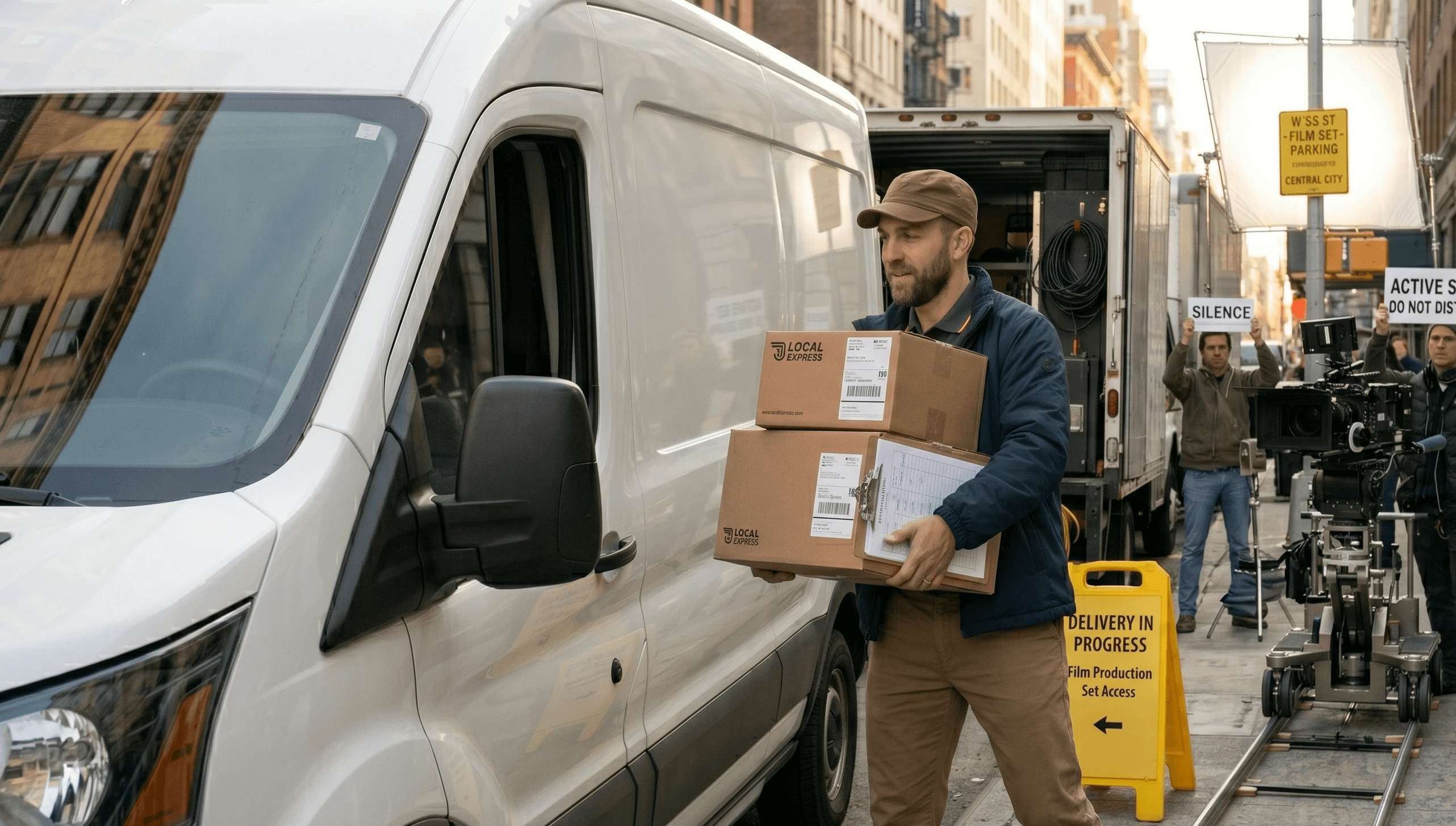
2026 changed the math on business delivery in New York. Congestion pricing is now a daily line item. National parcel carriers keep raising base rates while service windows get tighter. Gig courier apps that propped up small-business delivery for half a decade are quietly collapsing under driver churn and pricing instability. And the businesses that depend on reliable delivery — law firms running court filings, hospitals running specimens, retailers running store replenishment, ecommerce brands running last-mile fulfillment — are quietly migrating from app-based delivery back to dedicated, asset-based courier partners. This guide is for the operations lead, owner, or office manager trying to figure out what to actually do about it.
If you run a business in New York City, New Jersey, Connecticut, or eastern Pennsylvania and you move physical things between locations on a daily, weekly, or recurring basis, this is the playbook for choosing the right service, the right partner, and the right pricing model in 2026. We'll cover what changed this year, the four delivery models every NYC business should understand, how to pick by your industry, how to pick by your borough or county, how to think about interstate routes, what 2026 pricing actually looks like, and a checklist for evaluating any delivery vendor before you sign anything.
What changed for NYC business delivery in 2026
Congestion pricing is now a fixed cost. Every truck and van entering Manhattan below 60th Street pays the toll, every weekday. That cost gets passed through. Smart shippers offset it by consolidating runs, switching to scheduled recurring routes instead of ad-hoc deliveries, and choosing partners who optimize routing across multiple stops in the zone instead of paying the toll for a single drop. We broke down the financial math in our piece on congestion pricing and delivery costs in Manhattan — the short version is that recurring routes now save 20-40% versus on-demand for any business doing 3+ Manhattan deliveries a week.
Gig courier apps are unreliable for B2B. The model that made on-demand courier apps work — abundant drivers, low rates, tech-driven dispatch — is fraying. Driver acceptance rates are down, average pickup times are up, and the apps that promised same-day delivery starting at $9 are now quoting $40 with two-hour windows. We covered this transition in courier service vs. gig apps in NYC and why NYC businesses are switching courier companies in 2026. The businesses that depend on guaranteed delivery — legal filings, medical specimens, contracted retail replenishment, professional service deliverables — were never well-served by gig models, but the gap got worse this year, not better.
National carriers raised rates and tightened service. FedEx and UPS rate increases in 2026 made same-day shipping through national carriers economically unviable for most NYC businesses. We covered the cost comparison in NYC courier service cost in 2026 and the broader state of same-day delivery in NYC for 2026. The win for local courier companies is straightforward — when a major carrier loses a parcel, recovery is painful and slow; we covered the typical resolution path in what to do when FedEx loses a package.
The four delivery models every NYC business should understand
Most operations leads default to whatever delivery service they used last year. That's how businesses end up paying ad-hoc rush rates for what should be a scheduled route, or scheduling a freight pickup for what should be a same-day messenger run. Here are the four delivery models, what each one is built for, and how to think about which one matches your shipment.
1. Same-day delivery
Same-day delivery is the workhorse for NYC business operations — anything that needs to leave a sender and arrive at a receiver inside the same business day. The category covers a wide span. Document delivery for time-sensitive legal and contract work. Package delivery for retail and ecommerce drops under 50 pounds. Large item delivery for furniture, fixtures, and oversized goods that won't fit in a sedan. Critical deliveries for the moments where a missed delivery costs real money — closing documents, surgical equipment, broadcast tape, courthouse filings.
The right same-day vehicle depends on the shipment. Van and truck delivery handles palletized freight, multi-stop loads, and anything heavier than 100 pounds. Retail store delivery handles the daily dance of inventory between distribution centers and stores. Distribution warehouse delivery handles the inbound side. Construction materials and supplies delivery handles the chaos of urban job sites. Marketplace furniture delivery handles the long tail of resold and DTC home goods. Art delivery handles galleries, auction houses, and private collectors. Trade show delivery handles Javits, Brooklyn Expo, and the full convention circuit. Luggage pickup and delivery handles the hospitality and travel verticals. Beverage distribution delivery handles wholesale and event drops with temperature considerations.
For a deeper comparison of when same-day makes sense vs. overnight, we wrote same-day delivery vs. overnight: which to choose. For weekend coverage specifically, see Saturday, Sunday, and weekend courier service NYC.
2. Messenger services
Messenger services are built for smaller, faster, more frequent moves — a different category than same-day, even though there's overlap. The dispatcher logic is different, the vehicle mix is different, and the pricing is different. On-demand messenger service is the fastest tier — pickup-to-drop in under two hours for documents, samples, and small parcels. Rush and STAT messenger service compresses that further for genuine emergencies — under 60 minutes from call to pickup, often used for medical specimens and legal filings. Bike messenger service is still the fastest option for Midtown-to-Midtown moves under three miles where traffic and double-parking would beat a car.
Scheduled messenger and recurring delivery is the option most businesses underuse — a fixed pickup at a fixed time, the same driver, every business day. Multi-stop messenger route delivery consolidates several drops into a single optimized loop, which is how interoffice mail and law-firm courthouse runs actually get done economically. Rent-a-fleet messengers and vans is for the businesses that need allocated capacity for a project or season — your own dedicated drivers and vehicles without buying or leasing the fleet.
3. Logistics programs
Logistics is the level above ad-hoc delivery — multi-shipment programs with operational logic, contracts, and pricing built into the structure. Recurring and scheduled logistics is the program for businesses with predictable daily or weekly volume — interoffice mail loops, lab specimen routes, daily distribution runs. Vendor and supply chain logistics handles the hard last-mile problems for vendors selling into NYC — building access, COI requirements, freight elevator windows, union compliance, dock vs. street delivery.
Warehouse-to-store distribution moves inventory between regional distribution centers and retail locations on cadences the stores actually need. Dedicated fleet logistics is for enterprise contracts that need allocated capacity — vehicles and drivers reserved for one customer, scaled up for surge and back down without the customer carrying the asset risk. Final-mile logistics bridges the gap between national line haul and the actual customer in NYC — the layer where 3PLs, national carriers, and supply chain managers consistently fail without a local partner.
4. Specialized and freight courier
A subset of business deliveries don't fit any of the standard models. White-glove delivery is for shipments that require inside placement, careful handling, two-person teams, or assembly — high-end FF&E, executive office moves, gallery placements. Specialized delivery handles the long tail of unusual shipments. Freight delivery covers palletized and oversized loads. Freight forwarding services coordinates international and multi-modal shipments end-to-end.
More specialized: legal courier and court messenger services for filings, subpoenas, and chain-of-custody handling. Medical courier service for specimens, samples, pharmacy, and HIPAA-aware deliveries. Print and deliver for marketing, signage, and documents that need to be produced and routed in one workflow. Airport cargo delivery for JFK, LGA, and EWR pickups and drops. Next flight out for time-critical interstate shipments. Overnight courier service for time-flexible interstate runs that don't need next-flight pricing. Event delivery services for trade shows, weddings, and venue activations. Wedding logistics as a dedicated wedding-day vendor. Catering and meal delivery services for corporate catering and event food. Fashion courier NYC for runway, showroom, and editorial logistics. Home staging delivery for real estate and interior design. Office moving NYC for corporate relocations. Production equipment delivery for film, TV, and broadcast.
Choose your delivery partner by your industry
Every industry has its own delivery requirements — what gets moved, how often, what credentials the carrier needs, what the failure cost looks like when something doesn't show up on time. Below is the breakdown by vertical, with the dedicated industry resource for each.
Legal and law offices. Court filings, subpoena service, deposition transcripts, document production drops to opposing counsel — chain of custody matters, so does proof of delivery. We handle the full workflow for law, media, and business offices. Healthcare and medical labs. Specimen transport, blood draws, dental impressions, pharmacy transfers, pathology slides — HIPAA awareness and temperature-aware handling are non-negotiable. Coverage detail in healthcare and labs, dental lab pickup and delivery, and veterinary and animal hospitals.
Fashion and showrooms. Sample movement between showrooms, agencies, and shoots — runway logistics, photo-shoot returns, wholesale buyer deliveries during market weeks. Detail in fashion brands, showrooms, and agencies. Ecommerce and DTC. Last-mile fulfillment, returns, and same-day for high-velocity SKUs — covered in ecommerce and DTC. Construction and contractors. Job site delivery, building access, freight elevator coordination, COI on every drop — detail in construction contractors and material suppliers and architecture, engineering, and construction.
Wholesale, distribution, and 3PL. Pallet moves, store replenishment, EDI-compliant fulfillment — see wholesale distributors and warehouses and 3PL providers. Importers, exporters, and freight forwarders. Port-side coordination, container drayage, customs documentation — detail in importers, exporters, and freight forwarders. Print shops and marketing agencies. Print runs, signage, direct mail, agency-to-client deliverables — detail in print shops, PR, and marketing agencies.
Restaurants and food service. Inventory transfers, catering deliveries, supply runs — see restaurants and food service. Hotels and hospitality. Guest luggage, FF&E, kitchen supply, event setup — see hotels and hospitality. Real estate. Closing documents, key drops, staging materials — see same-day real estate courier. Insurance. Claims documents, adjuster materials, policy delivery — see insurance and claims offices. Accounting and financial services. Tax-season document movement, audit materials — see accounting and financial services.
Schools and testing centers. Standardized test materials, lab samples, multi-campus mail — see schools and testing centers. Floral shops and designers. Event-day deliveries with timing and temperature considerations — see floral shops and designers. Jewelry and high-value goods. Insured transport, signature capture, secure handling — see jewelry and high-value goods. Art galleries and auction houses. Climate awareness, white-glove handling, condition reports — see art galleries and auction houses.
Film, TV, and media production. Equipment moves, set deliveries, dailies — see production courier for film, TV, and media. Remote and hybrid offices. Equipment to and from employee homes — see remote office equipment pickup and delivery. Moving and storage companies. Overflow capacity for residential and commercial moves — see moving and storage delivery partner. Nonprofits. Donation pickups, event materials, program delivery — see nonprofit organizations.
Choose your delivery partner by your location
Where your business sits inside the metro changes the math. A retail brand in Bushwick has different delivery realities than a law firm in FiDi. Below is the breakdown by borough and by tri-state region, with the local coverage page for each.
Manhattan. Congestion zone now covers below 60th Street. Building access requirements are stringent. Coverage detail in Manhattan courier service, with neighborhood-level coverage for Financial District, Tribeca, and SoHo. Brooklyn. Borough-wide coverage detail in Brooklyn courier service, with neighborhood pages for Williamsburg, Bushwick, Downtown Brooklyn, Bed-Stuy, Flatbush, Park Slope, Crown Heights, and Bay Ridge. We covered the borough's full delivery landscape in our blog piece on Brooklyn courier service for every neighborhood and the dispatch logic in Brooklyn pickup in 60 minutes or less.
Queens. Coverage detail in Queens courier service, with neighborhood pages for Long Island City, Astoria, Sunnyside, Jackson Heights, Flushing, and Jamaica. The Bronx. See Bronx courier service. Staten Island. See Staten Island coverage.
Long Island, Westchester, Rockland. Tri-state suburbs with a different operating tempo than the boroughs. See Long Island courier, Westchester courier, and Rockland County courier. For Long Island specifically, the East End has its own service profile during summer — see Montauk courier. Mid-Hudson coverage runs through Middletown.
New Jersey. Full state coverage from the Hudson Waterfront through the Meadowlands and Route 287 corridor down to the Princeton biotech belt — see New Jersey courier service. Connecticut. Stamford-Greenwich Gold Coast through Hartford and the Fairfield County corporate corridor — see Connecticut courier service. We covered the deep play here in North Jersey courier service and same-day courier in New Jersey. Philadelphia and Eastern PA. See Philadelphia courier service.
Routes and interstate delivery
Most NYC businesses also ship to and from cities outside the immediate metro on a regular basis — sales reps based out of Boston, manufacturing partners in Pittsburgh, customers in DC, fulfillment centers in Allentown. Standard parcel can take three to five business days; same-day or next-day interstate via dedicated vehicle takes one. Below is the route map, with a dedicated page for each lane covering vehicle options, transit times, and pricing.
Tri-state corridors. The shortest and most-trafficked lanes — see NY to New Jersey, NY to Stamford, NY to Greenwich, NY to Hartford, NY to New Haven, and the seasonal NY to the Hamptons run. Brooklyn-Lakewood. A specific corridor with its own daily volume — see Brooklyn to Lakewood.
Mid-Atlantic. The corridor most NYC businesses ship across — see NY to Philadelphia, NY to Allentown, NY to Baltimore, NY to Washington DC, and NY to Richmond. New England. See NY to Boston. Upstate New York. See NY to Albany, NY to Buffalo, and NY to Rochester.
Midwest and Rust Belt. See NY to Pittsburgh, NY to Cleveland, NY to Detroit, and NY to Chicago. Southeast. See NY to Charlotte, NY to Raleigh, NY to Atlanta, NY to Nashville, NY to Orlando, and NY to Miami. Long-haul transcontinental. See NY to Houston and NY to California. Full route catalog at routes.
What business delivery actually costs in 2026
Pricing in NYC business delivery has moved toward two clear tiers: predictable contracted rates for businesses with recurring volume, and on-demand rates for everyone else. The on-demand market got more expensive in 2026 as gig apps tightened and national carriers raised rates. The contracted market actually got more competitive — local courier companies competing for recurring B2B volume have pricing room that gig and national don't.
Standardized pricing for most local moves runs at $3 per mile with a $125 minimum, with discounts for recurring volume, multi-stop loops, and dedicated capacity. We broke this down with worked examples in NYC courier service pricing and the broader market view in NYC courier service cost in 2026. For specific rate quotes by route and vehicle, run your own numbers through the courier pricing calculator. For a deeper look at what missing a deadline actually costs versus what reliable delivery costs, see the cost of missed deadlines. For the freight side, see same-day freight delivery and shipping. For pallet-specific economics, see benefits of pallet delivery for local businesses.
Vendor evaluation checklist for 2026
Before you sign a contract or open a recurring account with any delivery vendor, run them through this checklist. The questions below filter for actual operational capability — not the marketing copy on the website.
Insurance and credentials. Ask for the COI, ask for cargo insurance limits, ask for proof of DOT and FMCSA authority. We publish ours at licenses and credentials. Coverage and fleet. Ask what they actually own versus what they broker — see our fleet as a benchmark for what an asset-based courier looks like. Proof of work. Ask for case studies and references — ours live at case studies and testimonials. Recognition and accreditation. Industry associations and accreditation bodies are a sanity check — ours are documented at awards and recognitions.
Operational details. Ask how dispatch actually works, ask what the tracking experience looks like, ask what proof of delivery they capture. We document ours at how it works, delivery tracking explained, and the live tracking system. Quality assurance. Ask what happens when something goes wrong — see our quality assurance program and claims and feedback process. Specialized capability. Ask about chain-of-custody, COI delivery, fragile item handling, and time-window guarantees. Reference: legal document chain of custody, COI guide, shipping fragile items, and medical specimen handling.
Setup and onboarding. Ask what a first-time setup actually looks like and how long it takes — see our new business delivery setup guide and how to prepare an office for recurring delivery. For event-driven setups, see the event delivery planning checklist. For a clear comparison framework, see choosing courier vs. freight vs. mail. For NYC commercial vehicle compliance, see NYC delivery regulations for commercial vehicles.
How to start
If you've made it this far, you have what you need to make a decision. The fastest path to setup is opening a business account — we onboard most B2B accounts inside one business day, including COI delivery to your receiving buildings, dedicated dispatch contact, and configuration of your scheduled or recurring routes. You can open a business account directly, or contact us for a quote on a specific job, route, or program. For a deeper sense of the values driving how we operate, see about us and why choose us. For ongoing reading, the full resources library and blog cover the operational and strategic side of NYC business delivery in more depth.
Business delivery in 2026 is a different operation than it was three years ago. The companies winning at it are the ones that picked the right model for their volume, the right partner for their industry, and a contracted relationship for anything they ship more than three times a week. The math has moved in favor of asset-based local couriers. The question for your business is whether your current vendor is keeping up, or whether the cost of the delivery you didn't get is now larger than the cost of upgrading.