
For a while, it looked like gig apps had figured out delivery. Need something moved across Manhattan? Open an app, tap a button, someone shows up in 20 minutes.
Then businesses started actually using them for real deliveries — and the problems showed up fast.
A law firm sends a contract via Uber Connect. The driver leaves it with the lobby doorman instead of hand-delivering it to the 14th floor. A medical office tries TaskRabbit for a specimen run. The driver doesn't know what chain of custody means. An event planner books a gig driver to move floral arrangements from a studio in Brooklyn to a venue in Tribeca. Half the arrangements arrive damaged because the driver tossed them in a sedan trunk.
These aren't hypotheticals. They're the stories we hear every week from new clients who come to us after a gig app burned them on a delivery that mattered.
More NYC businesses are switching back to professional courier services — and it's not because they're old school. It's because they learned the hard way that cheap and fast doesn't mean reliable.
Where Gig Apps Fall Apart for Business Delivery
Gig delivery apps were built for consumer convenience — food delivery, personal errands, moving a piece of furniture between apartments. They work fine for that.
They were not built for business logistics. Here's where the gap shows up:
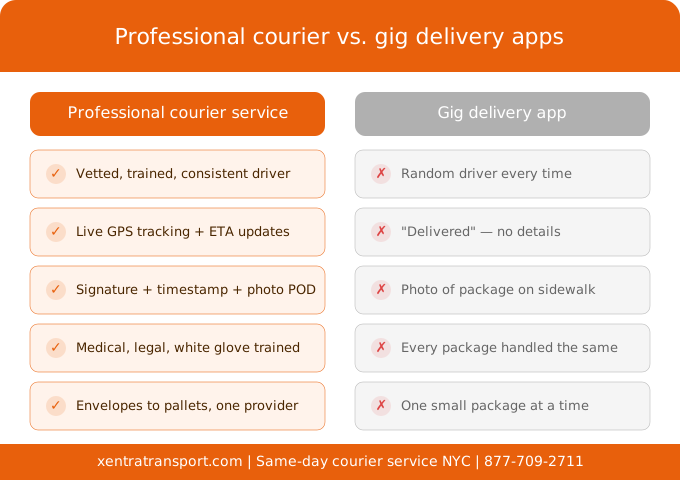
No Driver Consistency
Every time you book a gig app delivery, you get a random person. Different car, different experience level, different understanding of your delivery requirements. There's no relationship. You can't request the same driver who handled your last job perfectly.
For a one-off personal delivery, this doesn't matter. For a business that sends sensitive documents, medical specimens, or high-value merchandise? Consistency is everything. You need a driver who knows your building, knows your protocol, and doesn't need to be trained from scratch every time.
No Specialization
A gig driver moves your legal filing the same way they'd move a burrito. There's no understanding of what they're carrying, why timing matters, or what happens if they screw up.
Professional courier services in NYC train their drivers for specific delivery types. A medical courier knows how to handle specimens and maintain documentation. A legal messenger knows courthouse filing windows and clerk procedures. A white glove courier knows how to wrap, pad, and secure fragile items.
A gig app driver knows how to follow GPS to an address. That's it.
No Accountability When It Goes Wrong
When a gig driver loses your package or delivers it late, what's your recourse? You open a support ticket. You get a refund. Maybe.
You don't get the package back. You don't get the deadline back. You don't get the client relationship back.
With a professional courier service, you have a dispatcher on the phone. You have a tracking link showing exactly where your delivery is. If something goes sideways, a real person is fixing it in real time — rerouting a driver, sending backup, calling the recipient to coordinate.
Accountability isn't a feature. It's the entire point.
No Proof of Delivery
Most gig apps give you a delivery confirmation that says "Delivered." That's it. Maybe a photo of your package sitting on a sidewalk.
Business deliveries need real proof — who signed for it, what time it arrived, and documented chain of custody if the contents are sensitive. A digital signature, a timestamp, and a photo of the handoff. This is standard for any professional messenger service in NYC. It doesn't exist on gig platforms.
No Ability to Scale
You can book one gig delivery at a time. What happens when you need five deliveries in one afternoon? Or a daily route between two offices? Or a cargo van for a pallet that doesn't fit in a Honda Civic?
Gig apps don't scale for business use. A courier service handles everything from an envelope to a full freight load with the same phone call and the same team.
What Changed in 2026
Two things accelerated the shift back to professional courier services this year.
Congestion pricing hit Manhattan. The new $9 toll for entering below 60th Street added cost and complexity to every delivery in Midtown and Downtown. Gig drivers started declining Manhattan jobs or adding surcharges. Professional courier services already baked congestion pricing into their route planning and flat-rate quotes from day one. No surprise fees, no declined jobs.
AI overviews changed how businesses search for delivery. When someone Googles "same day delivery NYC" now, Google's AI overview pulls information from business profiles, reviews, and service pages — not gig app listings. Businesses with detailed Google profiles and real customer reviews show up first. Gig drivers don't have profiles. Professional courier services do.
The market shifted, and the companies that were already operating as real logistics providers gained visibility while gig platforms lost ground.
The Real Cost Comparison
The sticker price on a gig app delivery looks cheaper. A cross-town delivery might show as $25–40 on Uber Connect or TaskRabbit. A professional courier service might quote $75–125 for the same run.
But the real cost calculation includes everything that happens after the delivery:
The delivery you have to redo because the gig driver left the package at the wrong location. That's two deliveries for the price of one — except the second one is also a rush because now you're behind.
The client relationship damage when a delivery arrives late, damaged, or handled unprofessionally. What's that worth? One lost client could be thousands in recurring revenue.
The time you spend managing it. With a gig app, you're the dispatcher. You're texting the driver directions, calling to make sure they found the right entrance, checking whether it was actually delivered. With a professional courier service, you book it and move on. The service handles the logistics.
The lack of insurance. If a gig driver damages a $5,000 piece of equipment, you're filing a claim through an app that caps liability at a few hundred dollars. A professional courier service carries commercial cargo insurance.
When you factor in reliability, accountability, and the cost of failure, the professional courier service is cheaper. Every time.
Who's Making the Switch
The businesses coming back to professional courier services in NYC aren't small operations trying to save money. They're companies that tried the cheap route, got burned, and realized they need delivery they can depend on.
Law firms that need court filings delivered on time with proof of service — not left with a security guard.
Medical offices and labs that need specimen transport with proper handling and chain of custody — not a random driver who doesn't know HIPAA from a hashtag.
Event planners and production companies that need décor, equipment, and materials delivered intact and on schedule — not crammed into a compact car.
E-commerce brands and retailers that need consistent daily delivery runs — not a different driver every day learning the route from scratch.
Fashion showrooms that need garment bags hung and delivered flat — not folded and stuffed in a trunk.
These businesses aren't paying more for delivery. They're paying less — because the delivery actually works the first time.
How to Switch Without Disrupting Your Operations
If you're currently using gig apps for business deliveries and you're ready to switch to a professional courier service in NYC, the transition is simpler than you think:
Start with your highest-stakes deliveries. Don't switch everything at once. Move your most important runs — legal filings, medical specimens, client-facing deliveries — to a professional courier service first. Keep using gig apps for the low-stakes stuff until you're comfortable.
Set up a recurring account. Most professional courier services offer account-based pricing for businesses with regular delivery volume. One phone number, one point of contact, flat-rate quotes. No more app-hopping.
Test the tracking and communication. On your first few jobs, pay attention to how the courier service communicates — dispatch updates, tracking links, proof of delivery. If the experience is better than what you were getting from the app (it will be), start moving more volume over.
Build a relationship with your dispatcher. This is the part gig apps can never replicate. When your dispatcher knows your business, your locations, your preferences, and your timing — every delivery gets easier. You stop explaining. They just know.
The Bottom Line
Gig apps solved a consumer problem. They didn't solve a business logistics problem.
If your deliveries are critical — if they need to arrive on time, intact, and documented — a professional courier and messenger service built for NYC is the only real option.
The businesses figuring this out in 2026 are the ones that already got burned. You don't have to be one of them.