




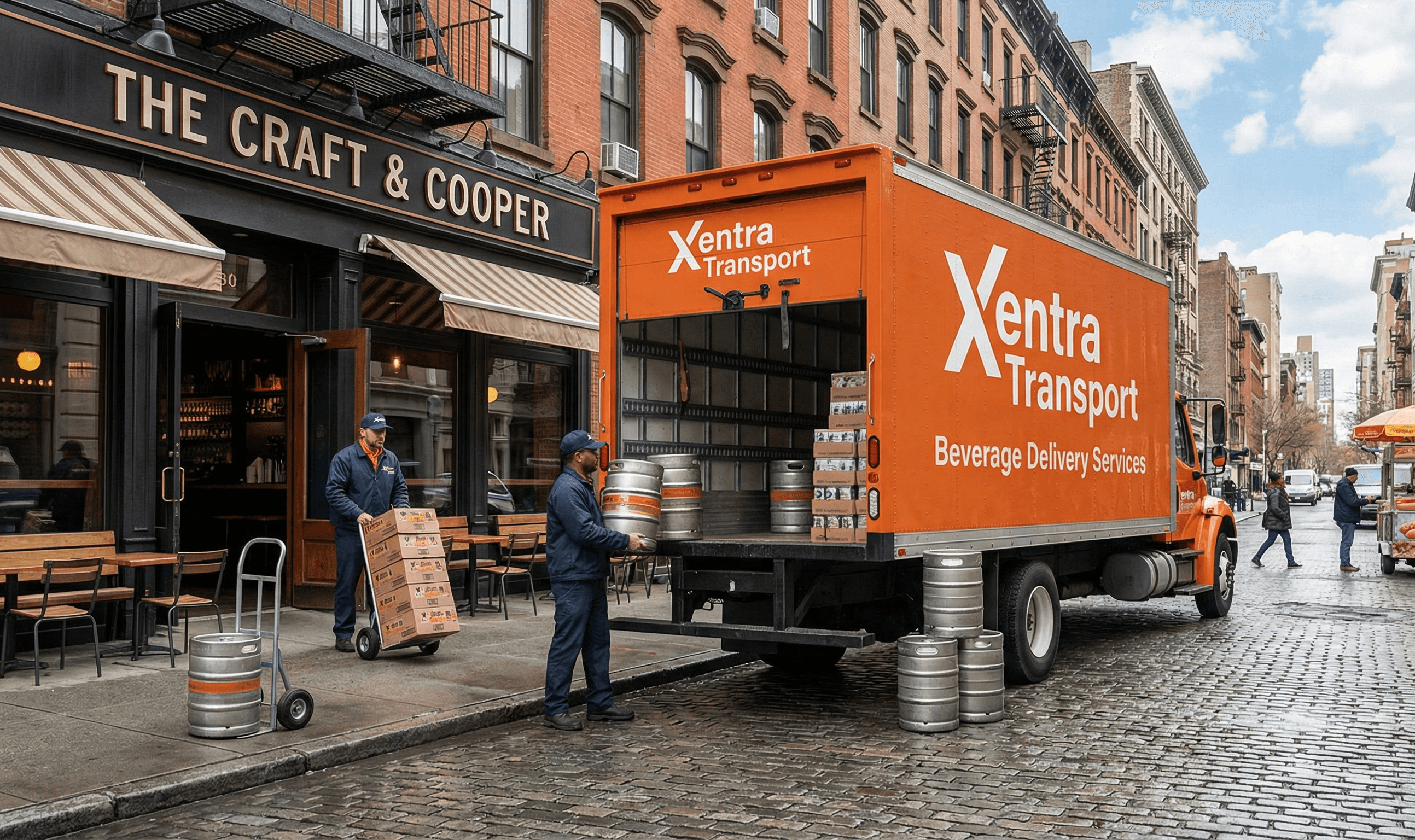
Running a bar in Williamsburg on a Friday night with no backup keg of the IPA the regulars ask for is a problem you only have once. Running a wedding venue in Tribeca when the wine pallet didn't make the morning delivery is a different kind of problem. Running a craft beer distributor pushing 80 pallets a week through Hunts Point and the broader NYC retail account base, and trying to do it on third-party gig drivers, is a problem at scale.
Beverage logistics in NYC is heavy, fragile, time-sensitive, and unforgiving — kegs weigh 161 lb full, glass breaks in transit, restaurants run on tight rotation cycles, and missing a delivery window means lost service and lost revenue. We run dedicated beverage distribution and last-mile delivery for the businesses that actually need it. Asset-based fleet — we own the trucks, employ the drivers, run the maintenance, carry the insurance — not marketplace gig drivers showing up in a sedan when the load is six kegs. Liftgate-equipped box trucks for sites with no dock. COI on file at no charge for any property management that requires it. Live GPS tracking on every truck. Photo proof of delivery on every job. Pricing is flat-rate, $125 minimum, $3 per mile after — quoted before dispatch.
What We Deliver : Beer, Wine, Spirits, Mixers, and Everything Behind the Bar
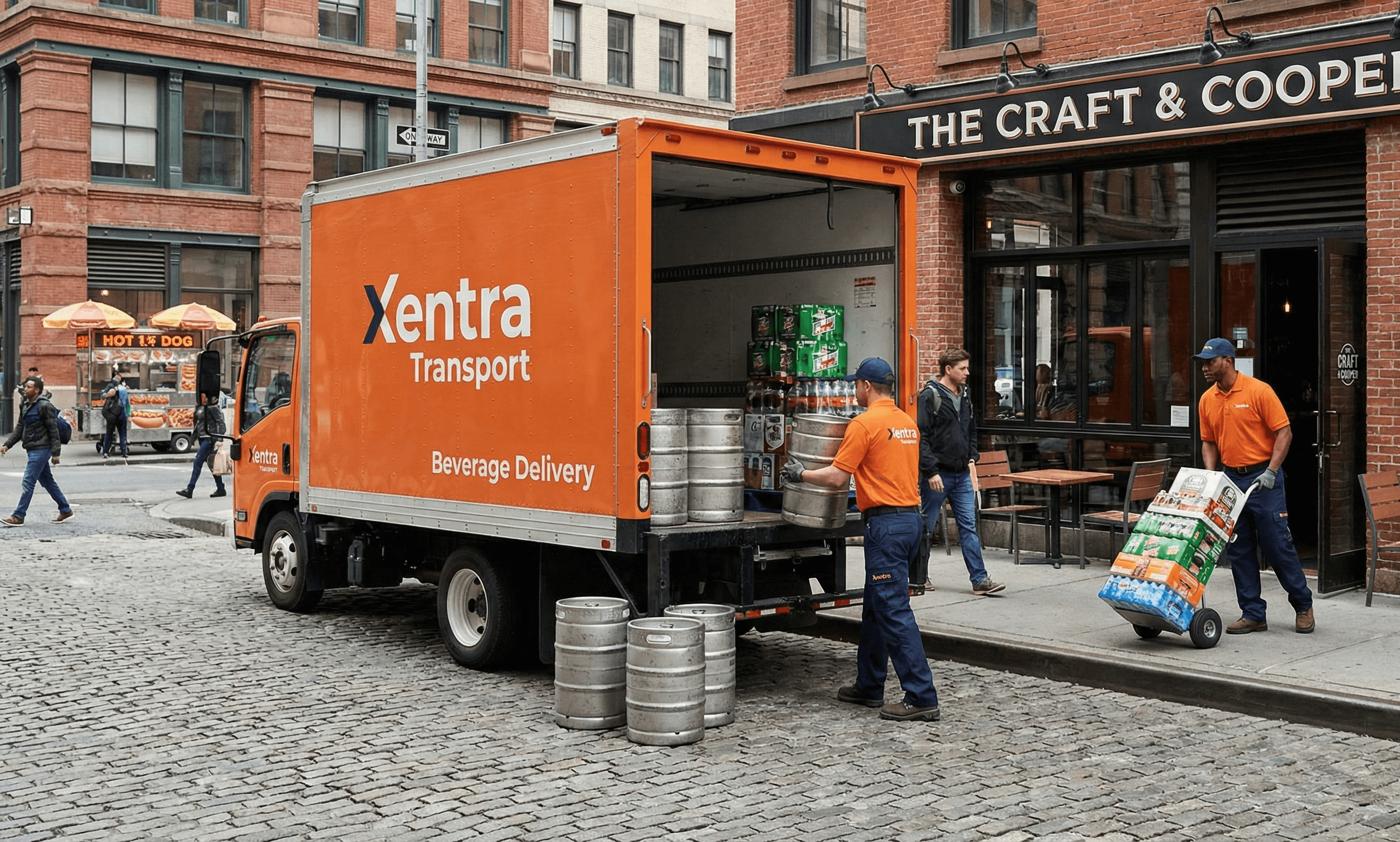
Beverage delivery is its own category with its own physics. Half-barrel kegs run 161 lb full and don't tolerate horizontal movement. Glass breaks when pallets shift. Wine cases stack differently than beer cases. Soda syrup boxes are heavy and prone to leaking if mishandled. The vehicle, the strapping protocol, the offload equipment, and the driver training all matter. We run trucks sized for actual beverage loads — cargo vans for small commercial deliveries, Sprinter vans for mid-size cases, and 16-26 ft box trucks with hydraulic liftgate for full pallet beer freight and multi-stop distributor routes.
Where We Move Everday:
Beer kegs — half barrels (15.5 gal / 161 lb), quarter barrels (7.75 gal), sixtels (5.16 gal), torpedo kegs, and standard 1/6 BBL formats — strapped vertical with proper securing, never tipped horizontal in transit
Beer cases and packs — 24-pack glass, 24-pack cans, 12-pack mixed packs, multi-packs, variety crates, and bulk shrink-wrapped pallets
Wine cases and pallets — table wine, fine wine, sparkling, bag-in-box, with extra padding for high-value bottles where breakage risk demands it
Spirits and liquor — full pallets, mixed pallets, single-case orders for restaurants, hotels, and event accounts; secure transport with chain-of-custody documentation when high-value collector or rare spirits move
Non-alcoholic beverages — bottled water cases, juices, sparkling water, kombucha, energy drinks, RTD coffee and tea, sports drinks
Soda syrups and bag-in-box — Coca-Cola, Pepsi, syrups for fountain systems, BIB tonics, BIB juices — handled with leak protection and proper temperature awareness
Mixers and bar essentials — tonic water, club soda, ginger beer, bitters, garnish supplies, fresh-squeezed juice cases for craft cocktail programs
Bulk event orders — pallets of canned beer for festivals, beverage stations for weddings, wine pallets for venue openings, full-bar setups for corporate events and trade shows
Specialty and craft beer — small-batch local brewery deliveries from NJ and NYC craft breweries to retail accounts, with same-driver custody and careful handling
Hospitality and restaurant resupply — emergency kegs when a tap blows mid-service, replacement cases when inventory runs low, daily resupply for high-volume bars and restaurants
For broader pallet and freight context, our freight delivery service handles full pallet freight up to 12,000 lb. The vans, trucks, and liftgate guide walks through which vehicle handles what beverage load. For pallet shipping specifics, see our how to ship a pallet from NYC guide and liftgate delivery guide.
2
Who's Actually Booking This — Distributors, Bars, Restaurants, Caterers, Venues
Beverage distributors and wholesalers make up a steady share of recurring volume. NY State licensed wholesalers (Manhattan Beer, S&Y Wine, Empire Distributors, Southern Glazer's, RNDC, Manhattan Beer & Beverage) run their own primary fleets but routinely need overflow capacity, hot-shot recovery runs when a primary truck breaks down mid-route, and surge support for peak season (summer outdoor venues, holiday season, festival circuit). We provide that overflow capacity with asset-based trucks and trained drivers, integrated into the distributor's dispatch when needed. Smaller craft distributors and direct-to-retail brands without their own fleet use us as their full last-mile execution arm — picking up at the brewery or warehouse, running multi-stop routes through retail accounts, returning empty kegs and packaging at the end of the route. Detail at our wholesale distributors NYC industry page and the warehouse and DC distribution delivery framework.
▼ Bars, restaurants, and nightclubs book emergency kegs when a tap blows during service, daily and weekly resupply runs from suppliers and warehouses, and pre-event volume builds for big nights. The Hospitality industry detail at our hotels and hospitality industry page. Volume corridors include the Manhattan bar belt across East Village, Lower East Side, West Village, Hells Kitchen, Chelsea, and Hudson Yards; the Brooklyn brewery and bar district through Williamsburg, Greenpoint, Bushwick, Bed-Stuy, DUMBO, Park Slope, Bay Ridge, and Crown Heights; the Queens nightlife corridor through Long Island City, Astoria, and Jackson Heights; and the Bronx and Staten Island bar networks. NYC has roughly 25,000+ on-premises liquor licenses across the boroughs, and most of them need beverage logistics that don't break down on a Friday night.
▼ Hotels book wedding-venue beverage logistics, corporate event bar setups, ongoing F&B resupply for hotel restaurants and lounges, in-room minibar restock at scale, and event-driven beverage volume tied to corporate retreats and conferences. Major NYC hotel corridors — Midtown, Hudson Yards, the Financial District, and the cross-Hudson high-rise hotel cluster in Jersey City and Hoboken — generate continuous volume. Hotel deliveries usually require COI on file, freight elevator booking, and specific timing windows that don't disrupt guest operations. We coordinate the access workflow as standard practice — detail at our Manhattan high-rise delivery guide, Certificate of Insurance guide, and white glove delivery service for premium hospitality FF&E that often pairs with beverage delivery on hotel install jobs.
▼ Caterers, event planners, and venue operators book beverage delivery for wedding venues, corporate events, festival circuits, brand activations, fashion week parties, sporting events, and private parties. Event volume runs unpredictable — a single major event can pull 200+ cases of beer and 50+ cases of wine for a single afternoon. The vehicle, the timing, the load-in protocol at the venue, and the breakdown / dead inventory pickup at the end all matter. Coordinated through our event delivery services, catering and meal delivery, and wedding logistics service. Trade show and convention beverage delivery to Javits, Pier 36, the Meadowlands Exposition Center in Secaucus, and the NJ Convention Center in Edison — operational detail in our trade show booth delivery guide. Event delivery framework at our event delivery planning checklist.
▼ Retail liquor stores, beer-centric grocery, and convenience accounts book recurring resupply runs from distributors and direct-to-retail craft brands. NYC has approximately 4,000+ off-premises liquor stores across the boroughs and a growing number of beer-focused specialty grocers, especially in Brooklyn and Manhattan. Retail volume runs differently than restaurant volume — predictable schedules, weekly cadence, mostly daytime delivery windows, and tight dock-or-storefront access requirements that often need liftgate. Detail at our retail store delivery NYC and the recurring delivery prep guide for setting up scheduled routes that lock in flat monthly pricing.
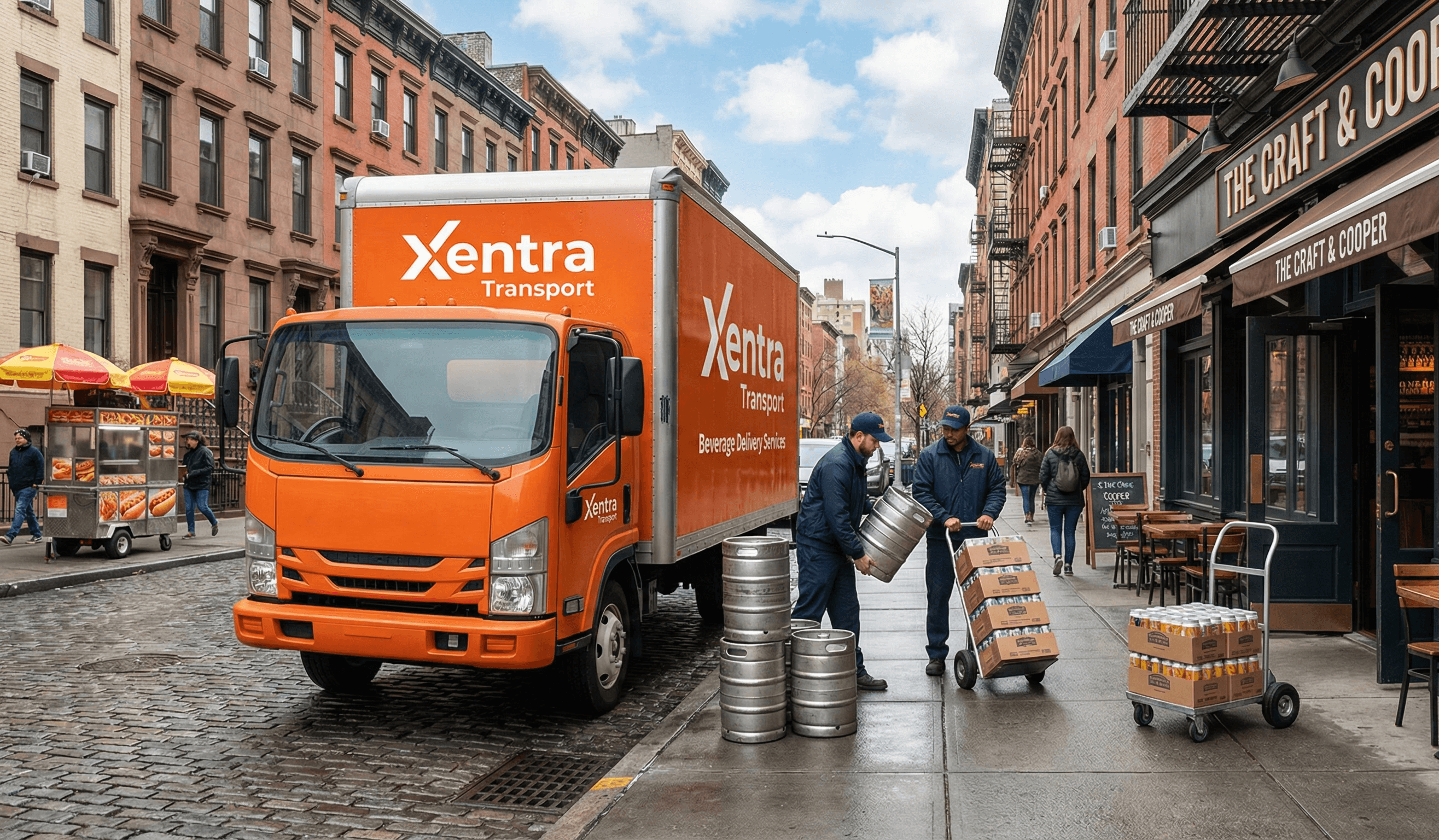
A regular freight carrier moves a pallet from point A to point B. Beverage logistics is its own discipline because the load fights you every step of the way: weight per unit is brutal, glass breaks easily, kegs require vertical securing, temperature matters more than people realize, alcohol carries regulatory considerations, and the receivers are operating on tight service-time windows that don't tolerate "we'll be there sometime between 1-5 PM."
What separates real beverage logistics from generic freight:
Weight per unit — A standard half-barrel keg is 161 lb full. A 24-pack of glass beer is 35 lb. A pallet of canned beer (typically 70-100 cases shrink-wrapped) runs 1,800-2,400 lb. Cargo weight rules everything about vehicle and crew sizing
Vertical securing for kegs — Kegs that ride horizontal in transit get foamy on tap. Kegs that get tipped over and shaken during transit can lose carbonation entirely. We strap kegs vertical, use proper dunnage between rows, and never stack heavy on glass
Glass-on-glass protection — Wine cases and beer cases need cardboard separators or shrink-wrap consolidation. Direct glass-on-glass during a sharp turn on the BQE breaks bottles
Temperature awareness — Beer doesn't tolerate extreme heat (above ~75°F starts skunking) or freezing (below 32°F damages the bottle and can affect carbonation). Our trucks run insulated cargo areas, and during summer heat waves we route deliveries to avoid extended sit-time at distribution stops
NY State alcohol regulations — NY State Liquor Authority (SLA) sets specific rules about who can transport alcohol. Licensed beverage carriers, distributor-owned trucks, and properly-credentialed third-party logistics providers can all transport — but the chain of custody and documentation matters. We coordinate documentation requirements with distributor and licensee partners
Tight delivery windows — Bars and restaurants don't have 4-hour delivery windows. They open at 4 PM. They run service from 5-11 PM. Deliveries either land between 9 AM-3 PM (most common) or after 12 AM (emergency keg replacement during service). Our dispatch sizes the delivery to the receiver's actual operational rhythm
Empty keg returns — Kegs are returnable. Distributors charge keg deposits ($30-50 per keg) that the bar gets back when the empty returns. Same-driver custody on the return cycle, photo verification of the empties at pickup, and proper securing during transit
Breakage liability — Beverage carriers carry cargo insurance that specifically covers liquid product. Marketplace apps and gig drivers don't have this coverage. When a glass case breaks during a marketplace-app delivery, the loss falls on the shipper
The honest test of any beverage carrier: ask them what protocol they use for kegs, how they secure pallets in transit, what happens when a case breaks, and whether they have cargo insurance covering liquid loss. Generic carriers don't have answers. Marketplace apps definitely don't have answers. We do — because beverage volume is what we run continuously across the Brooklyn brewery district, the Manhattan bar corridor, the Hudson Waterfront hospitality belt, and the broader NYC and NJ on-premise and off-premise account network.
3
4
Manhattan Manhattan beverage volume concentrates in the bar and restaurant corridors. The East Village, Lower East Side, West Village, SoHo, Tribeca, and Greenwich Village bar belts run continuous nighttime hospitality volume. Hells Kitchen, the Garment District, and the broader Midtown hotel and corporate hospitality belt drive daytime hotel and event volume. Hudson Yards and the Financial District handle corporate event and luxury hotel volume. Chelsea, Flatiron, Gramercy, Kips Bay, and Murray Hill blend retail liquor stores, restaurants, and event venues. Battery Park City, Upper East Side, Upper West Side, and the Harlem-East Harlem-Washington Heights corridor cover the rest. Manhattan delivery requires careful loading-dock vs. street-pickup coordination — most boutique bars and restaurants don't have docks, so liftgate dispatch is standard.
▼ Brooklyn Brooklyn is the densest brewery and craft beer market in NYC. Williamsburg and Greenpoint host major NYC craft breweries — Brooklyn Brewery, Other Half, Threes Brewing, and the broader brewery cluster pulling regional beer volume. Bushwick hosts more brewery and beer-bar volume. The Park Slope-Cobble Hill-Carroll Gardens brownstone bar belt, Bed-Stuy, Crown Heights, Bay Ridge, Bensonhurst, Borough Park, Sunset Park, Sheepshead Bay, Red Hook, Downtown Brooklyn, DUMBO, Brooklyn Heights, Flatbush, and East New York round out the Brooklyn delivery footprint. Brooklyn's craft beer industry pushes regional distribution volume to retail accounts across NYC and NJ — we coordinate brewery-to-retail multi-stop routes for the smaller craft distributors that don't run their own fleet.
▼ Queens Queens beverage volume runs through Long Island City, Astoria, Sunnyside, Woodside, Jackson Heights, Elmhurst, Flushing, Forest Hills, Rego Park, Bayside, Jamaica, Howard Beach, Maspeth, Ridgewood, Ozone Park, Corona, and College Point. Queens hosts a strong neighborhood bar and restaurant network, plus the JFK and LaGuardia airport hospitality clusters. JFK-area beverage logistics for cargo and concession accounts coordinate through our airport cargo delivery service. Queens craft brewery volume includes Astoria's beer scene and the broader Queens brewery network.
▼ Bronx + Staten Island Bronx beverage delivery covers Mott Haven, Port Morris, Melrose, Hunts Point (the largest food and beverage distribution complex in the country — major beer and beverage volume runs through Hunts Point daily), Concourse, Highbridge, Fordham, Belmont, Riverdale, Bedford Park, Norwood, Williamsbridge, Baychester, Eastchester, Mount Hope, University Heights, Country Club, Clason Point, Longwood, Morris Heights, and Port Morris. Hunts Point distribution runs continuously — we provide last-mile capacity from the Hunts Point terminal to retail and on-premise accounts citywide. Staten Island runs cover St. George, Tompkinsville, Stapleton, Todt Hill, Great Kills, Tottenville, West Brighton, Port Richmond, and the broader borough.
▼ NJ + Tri-State NJ beverage volume runs through the wholesaler distribution corridor and the cross-Hudson hospitality belt. The Meadowlands warehouse cluster in Secaucus, North Bergen, Kearny, and Teterboro hosts major beer and beverage distribution warehouses serving the entire NYC metropolitan market. Hudson Waterfront hospitality runs daily across Jersey City, Hoboken, Weehawken, Union City, Bayonne, North Bergen, and West New York — high-rise hotels, restaurants, and event venues with strict COI requirements. Bergen County coverage extends to Hackensack, Paramus, Fort Lee, and Teaneck. The Newark hospitality and corporate event cluster runs through Newark, East Orange, Elizabeth, Linden, and Nutley. Mercer and Middlesex County distribution covers Edison, New Brunswick, Princeton, Trenton, Cranbury, Piscataway, and Woodbridge. Cross-Hudson volume on the NY-to-NJ corridor; cross-state delivery to PA on the NY-to-Philadelphia route, to MA on the NY-to-Boston route, and to DC on the NY-to-DC route. Lakewood Orthodox community kosher beverage logistics on the Brooklyn-to-Lakewood corridor. Full NJ network through the NJ courier hub with dedicated NJ freight delivery operations.
The right vehicle for beverage delivery is determined by load volume, weight, and the receiver's offload conditions. A boutique bar in SoHo taking delivery of two kegs and a couple of cases needs a cargo van and a single trained driver. A craft distributor running a multi-stop route through 8 Brooklyn retail accounts needs a Sprinter or 16-ft box truck. A wedding venue load-in with 6 pallets of beer, wine, and spirits needs a 24-26 ft box truck with liftgate.
What we run:
Cargo vans (Ford Transit, RAM ProMaster) — 2,500-4,000 lb payload, 1-2 pallets, 250-450 cu ft cargo. Best for small commercial deliveries — 4-8 cases of wine, 2-4 kegs, single-store retail resupply, emergency keg runs to bars during service
Sprinter vans (high-roof, long wheelbase) — 3,000-5,000 lb payload, 2-3 pallets, 350-550 cu ft. Best for mid-size routes, multi-stop retail runs, mid-tier event load-ins
16-ft box truck with liftgate — 3,500-4,500 lb payload, 4-6 pallets, ~800 cu ft. Standard distributor multi-stop vehicle
20-ft box truck with liftgate — 5,000-7,500 lb payload, 6-8 pallets. Mid-volume distributor routes and event load-ins
24-ft / 26-ft box truck with liftgate — 9,000-12,000 lb payload, 10-12 pallets. Full-pallet distributor freight, festival load-ins, large catering setups, full bar build-outs for weddings and corporate events
Typical pricing scenarios:
Single emergency keg run to a bar mid-service — typically $125-200 depending on distance and time of day
Bar resupply (4-8 cases + 2-4 kegs) — typically $150-250 for an intra-borough run
Multi-stop distributor route (4-6 retail accounts) — typically $400-650 with single Sprinter or 16-ft truck
Wedding venue beverage load-in (3-6 pallets mixed) — typically $450-850 with 20-24 ft truck and crew
Festival or large event (8-12 pallets) — typically $800-1,400 with 26-ft truck and crew
Cross-Hudson runs to Jersey City, Hoboken, or further into NJ — add $50-200 for tunnel/bridge time
Recurring scheduled routes (3+ runs/week to consistent destinations) — flat monthly contract typically cuts per-run cost roughly in half
Pricing is flat-rate quoted before dispatch — no surge pricing, no surprise stair fees, no acceptance lottery, no per-pound creep. Full pricing detail across vehicle, distance, and accessorial scenarios in our 2026 NYC courier pricing guide; pricing calculator at our courier pricing calculator. Saturday and Sunday delivery available with a transparent weekend surcharge — detail at our weekend courier guide. After-hours and overnight runs through our overnight courier service and NJ 24/7 dispatch — critical for emergency keg replacement during late-night service.
Why Beverage Businesses Pick Us Over Gig Apps and Generic Freight Carriers
Marketplace courier apps (Roadie, GoShare, Lugg, Dolly, TaskRabbit) — Driver who accepts your job has zero training in beverage handling. Drivers show up in whatever vehicle they happen to drive, sometimes a sedan when the load is six kegs. No cargo insurance covering liquid loss. No COI workflow. No empty-keg return capability. Driver churn rates run 75%+ annually, no consistency from week to week. Surge pricing kicks in at the worst times. Acceptance lottery means your run might sit unaccepted while you're 90 minutes from service start. Detail at our courier service vs gig apps NYC blog
Generic LTL freight carriers (FedEx Freight, XPO, Estes, R+L) — Built for cross-country pallet freight, not local same-day beverage. Standard transit times of 2-3 business days for a 15-mile NYC delivery, 4-hour delivery windows, no flexibility for the actual operational rhythm bars and restaurants run on. No emergency mid-service keg replacement capability. Liftgate is an extra accessorial fee that often doubles the effective rate of a small pallet shipment
Distributor-owned fleets (running internal) — Work fine for the distributor's primary routes but lack overflow capacity and rarely run nighttime emergency replacement runs. We provide the overflow layer that distributors need without competing for their primary business
Asset-based same-day beverage logistics (what we run) — Sized exactly for beverage delivery. In-house drivers trained in beverage handling. Asset-based fleet — we own the trucks, employ the drivers, run the maintenance. Full cargo insurance covering liquid loss. COI workflow as standard practice. Empty keg returns coordinated as part of multi-stop routing. Live GPS tracking on every truck. Photo proof of delivery on every job. Flat-rate pricing without surge math
The honest test of any beverage carrier is what happens at 11 PM on Friday when a keg blows mid-service. Marketplace apps are 30-90 minutes away from accepting the job, with no guaranteed driver. Generic LTL closes at 5 PM. We dispatch from in-house at 11 PM with a trained driver and a properly equipped truck. That's the operational difference that decides whether your service stops or keeps running.
Beverage Delivery FAQ
▼ FAQ 1 — Q Can you deliver alcohol legally in NYC?
▼ FAQ 1 — A Yes — we operate within NY State Liquor Authority (SLA) rules for third-party logistics providers transporting alcohol. The chain of custody runs from licensed seller to licensed receiver, with us providing the transportation layer between. We coordinate documentation requirements with distributor and licensee partners as part of dispatch. We don't sell alcohol, hold liquor licenses, or perform retail alcohol sales — we provide the delivery transport service.
▼ FAQ 2 — Q How much does beverage delivery cost?
▼ FAQ 2 — A $125 minimum, $3 per mile after, with vehicle size, crew, distance, and access constraints determining the final rate. A single emergency keg run typically runs $125-200. A bar resupply with 4-8 cases plus 2-4 kegs typically runs $150-250. A multi-stop distributor route runs $400-650. A wedding venue load-in with 3-6 pallets runs $450-850. A festival or large event load-in runs $800-1,400. Full breakdown in our 2026 NYC courier pricing guide.
▼ FAQ 3 — Q Do you deliver kegs?
▼ FAQ 3 — A Yes — we move half barrels (15.5 gal / 161 lb), quarter barrels (7.75 gal), sixtels (5.16 gal), torpedo kegs, and standard 1/6 BBL formats every day. Kegs ride strapped vertical with proper dunnage between rows. Empty keg returns coordinated as part of multi-stop routing.
▼ FAQ 4 — Q What about emergency keg replacement during service?
▼ FAQ 4 — A Yes — emergency mid-service runs are common volume. A bar in Williamsburg blows the IPA keg at 9 PM Friday, calls dispatch, and we dispatch a trained driver with a properly equipped truck. Pickup at the distributor or warehouse, delivery to the bar, often inside 60-90 minutes depending on distance and traffic. After-hours and overnight runs through our overnight courier service and NJ 24/7 dispatch.
▼ FAQ 5 — Q Do you handle pallet loads of beer and wine?
▼ FAQ 5 — A Yes — full pallet loads through our 16, 20, 24, and 26-ft box trucks with hydraulic liftgate. Capacity ranges from 4 pallets up to 12 pallets per truck, with payloads up to 12,000 lb. Full vehicle stack at our van and truck delivery NYC and freight delivery service.
▼ FAQ 6 — Q Do you do recurring distributor routes?
▼ FAQ 6 — A Yes — recurring routes for distributor multi-stop operations, daily restaurant resupply, weekly retail accounts, and surge support during peak season. Recurring contracts typically cut per-run cost roughly in half compared to on-demand pricing, locked into a flat monthly rate with dedicated drivers. Setup framework at our recurring delivery prep guide.
▼ FAQ 7 — Q Can you pick up empty kegs and return them to the distributor?
▼ FAQ 7 — A Yes — empty keg returns are coordinated as part of multi-stop routing. Same-driver custody on the return cycle, photo verification of empties at pickup, and proper securing during transit. Important for the keg deposit accounting that distributors track ($30-50 per keg deposit returned when the empty comes back).
▼ FAQ 8 — Q Do you deliver to events, festivals, and weddings?
▼ FAQ 8 — A Yes — event load-ins, festival deliveries, wedding venues, corporate events, and trade-show beverage logistics through our event delivery services, wedding logistics service, and trade show delivery. Operational guides at our event delivery planning checklist and trade show booth delivery guide.
▼ FAQ 9 — Q Do you deliver beverages to NJ and the broader tri-state?
▼ FAQ 9 — A Yes — daily volume on the NY-to-NJ corridor and across the full NJ courier network. Hudson Waterfront, Bergen County, Newark hospitality, Mercer biotech-corporate, and the broader 21 NJ counties through the NJ freight delivery service. Cross-state on the NY-to-Philadelphia route, the NY-to-Boston route, and the NY-to-DC route.
▼ FAQ 10 — Q What's your liability if a case breaks or a pallet falls during transit?
▼ FAQ 10 — A We carry full cargo insurance covering liquid product loss. When something breaks during transit, the claim runs through our carrier insurance, not the shipper's policy. Photo PoD at pickup and drop, GPS track, and recipient signature mean damage claims resolve fast with documentation already in hand. Detail at our failed delivery handling guide.
▼ FAQ 11 — Q What about temperature control for beer and wine in summer?
▼ FAQ 11 — A Beer doesn't tolerate sustained temperatures above ~75°F (starts skunking) or below freezing (damages bottles and affects carbonation). Our trucks run insulated cargo areas, and during summer heat waves we route deliveries to minimize sit-time at distribution stops. For genuinely temperature-critical loads (fine wine, certain craft beers), refrigerated transport available on request — coordinate at booking.
▼ FAQ 12 — Q Do you handle fine wine, rare spirits, and high-value collector items?
▼ FAQ 12 — A Yes — secure transport with chain-of-custody documentation, photo proof at pickup and drop, recipient signature, and insurance coverage scaled to the load value. For rare or high-value collector items requiring extra protection, our white-glove delivery service protocols apply (corner protection, vertical securing, single-driver custody).
RELATED RESOURCES