
When a sealed envelope leaves a paralegal's hand at 9:47 a.m. and lands on a clerk's desk in Brooklyn Supreme at 11:12 a.m., something has to prove what happened in between. That something is the chain of custody.
If you're moving deposition exhibits, original notarized contracts, court filings, blood samples and clinical specimens, controlled substance records, sealed bid responses, or anything that could end up referenced in a filing or audit, "we got it there fast" is not enough. The courier needs to be able to answer three questions on demand: who had it, when did they have it, and how do we prove the seal was never broken.
Most same-day couriers in the NYC and tri-state area can't answer those questions. The ones who can are the ones you want on speed dial.
What "chain of custody" actually means for a courier
Chain of custody is a documented, unbroken record of every person who handled a piece of evidence, paperwork, or sensitive cargo from pickup to delivery. The concept comes from criminal forensics — prosecutors have to prove a blood sample wasn't tampered with between the crime scene and the lab — but the principle now lives in dozens of other places: HIPAA, the Federal Rules of Evidence, SOX, FDA Title 21, ISO 17025, and almost every law firm's internal compliance manual.
For a courier company, it means six things in practice:
A single named driver is assigned to the shipment, not a relay of strangers.
Time-stamped pickup and delivery are captured with GPS-tracked coordinates, not just "delivered 11ish."
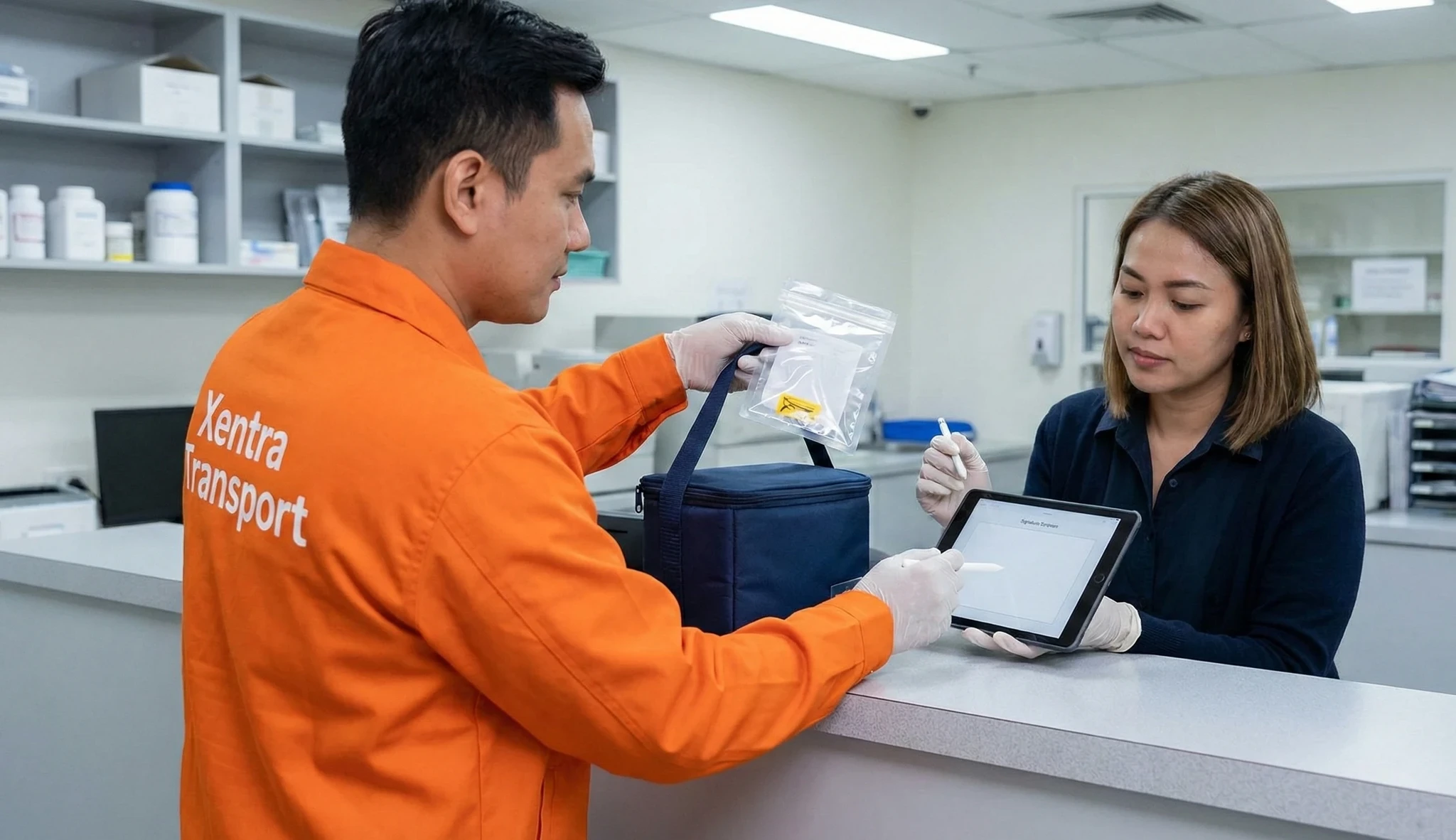
The recipient signs — physically or with a verified e-signature — and the signature is tied to the parcel's tracking ID.
Tamper-evident packaging is used and photographed at both ends.
An auditable record exists that can be exported as a PDF and handed to opposing counsel, an auditor, or a regulator. This is the core of any real quality-assurance protocol.
The driver can testify if needed about what they picked up, from whom, and where it went.
A courier app that just says "delivered" with a thumbs-up emoji is not chain of custody. That's a notification. (This is also one of the biggest differences between a real courier service and a gig delivery app.)
Who actually needs this
The clients who care about chain of custody fall into five rough buckets, and almost all of them are concentrated in the tri-state area:
Law firms and litigation support. Original wet-ink documents, deposition transcripts, exhibits being walked to a courthouse, sealed discovery materials, subpoena responses. If it could be excluded from evidence because the foundation can't be laid, it needs a chain. This is exactly what dedicated legal courier and court messenger services exist for. (If you're not sure whether you need a courier or a process server, we have a guide on that too.)
Healthcare, hospitals, and clinical labs. Patient specimens, controlled substances moving between pharmacies, clinical trial samples under temperature control, medical records, imaging media. HIPAA doesn't explicitly use the phrase "chain of custody," but the audit-trail requirements amount to the same thing — which is why dedicated medical couriers are a different animal from regular same-day services. Dental labs operate under similar requirements.
Corporate compliance and finance. Sealed bid responses, original board minutes, tax documents headed to an auditor, M&A deal documents being walked between law firms, secure destruction pickups for shredding. Most of this lives in the same-day document delivery category.
Manufacturing, warehouses, and 3PL operations. Prototype hardware moving between a design firm and a manufacturing partner, IP-sensitive samples, calibration equipment that has to maintain ISO traceability, recalled product being pulled from a distribution center. For high-value cargo this overlaps with specialized delivery and jewelry and high-value goods transport.
Court filing services. Anything physically walked into a New York or New Jersey courthouse before a 4 p.m. deadline. The filer needs proof of the time the document hit the clerk's window, not the time it left the office — which is exactly how court filing delivery works in NYC when it's done correctly.
If you're reading this and thinking "that's most of what I send out," you're in the majority. The mistake most teams make is assuming their existing courier handles all of it the same way they handle a lunch order.
What a proper chain of custody handoff looks like
Here's the protocol a serious same-day courier in the tri-state area should be running every time. Walk through this with your provider — if they can't describe it without hedging, that's your answer.
Before pickup. The courier confirms the sender, recipient, parcel description, and any special handling requirements in writing. A tracking ID is generated before the driver leaves their previous job, not after they arrive.
At pickup. The named driver arrives, presents ID, photographs the sealed package, captures the sender's signature with a time and GPS stamp, and confirms the destination address with the sender on the spot. The parcel goes directly into the van — not into a sorting hub, not transferred to another driver, not consolidated with unrelated freight.
In transit. The dedicated van is tracked continuously. The driver does not make unscheduled stops. For temperature-sensitive cargo (medical samples, certain pharmaceutical products), the container is monitored. For high-value or court-bound items, there's a documented protocol for what happens if the van is in an accident or the driver is incapacitated.
At delivery. The recipient is identified — by name, by photo ID for the most sensitive deliveries, or by a pre-shared PIN. They sign. A delivery photo is taken. The recipient gets a confirmation email or SMS within seconds, and the sender gets the same. Time and GPS are stamped to the second.
After delivery. The full record — pickup time, route, transit duration, delivery time, photos, both signatures, driver name — is stored for at least the duration required by the relevant compliance regime, and can be exported as a court-ready PDF on request. This is what a real quality-assurance program produces.
This is not exotic. It's what dedicated same-day couriers have been doing for decades. It's also what most app-based gig delivery services structurally cannot do, because their model depends on swapping drivers and consolidating cargo.
Red flags when you're vetting a courier
If you're looking at chain of custody providers in NYC, New Jersey, or the broader tri-state, here are the things that should make you walk away.
The driver is anonymous in the tracking interface. If you can't see a name, you can't subpoena one.
The package moves through a sortation hub. Every additional pair of hands is a break in the chain that opposing counsel can pick at.
The "proof of delivery" is a checkbox, not a signature plus photo plus timestamp.
The company can't tell you, in plain English, what happens if the parcel goes missing in transit. A real chain of custody operation has an incident protocol and has used it.
The pricing structure incentivizes the driver to consolidate. Per-stop pricing with bonuses for batching is how relay-style courier networks operate — fine for retail returns, not fine for an original notarized agreement. (For context on what fair pricing actually looks like, see our NYC courier service pricing guide for 2026.)
The contract has no liability provision specific to documentary or evidentiary value. If your courier's max liability is "the cost of replacing the envelope," you have a problem — and they probably can't produce a proper certificate of insurance for high-rise building access either.
How to choose a same-day courier in the tri-state area
Beyond the chain of custody specifics, there are practical questions worth asking any courier service in NYC, New Jersey, Brooklyn, Manhattan, or the surrounding tri-state region. (We've written a longer guide to choosing the best NYC courier service if you want the full version.)
Do they own their vehicles and employ their drivers? Contracted gig drivers don't carry the same accountability. A company running its own fleet of dedicated cargo vans with W-2 drivers has a different risk profile.
What's the longest deadline they'll commit to in writing? "Same-day" can mean a lot of things. A real same-day courier service NYC clients can rely on will give you a guaranteed window — typically under two hours for standard same-day pickup, 60 to 90 minutes for emergency and critical deliveries, and even faster via rush STAT messenger service for medical and legal emergencies.
Can they handle pallets and packages from the same provider? Most teams don't want one vendor for envelopes and a different one for the time you need to move three pallets of trade show materials to the Javits Center. A courier that scales from a single document up to dedicated truck and fleet logistics is more useful than two specialists. (Curious about freight specifically? Our LTL delivery services NYC/NJ guide covers the basics.)
Do they cover the geography you actually use? Manhattan, Brooklyn, Queens, the Bronx, Staten Island, Long Island, Westchester, Paterson, Newark, Jersey City, Hoboken, and the broader New Jersey corridor — verify they actually run there, not just advertise it. (Our full service area map covers every neighborhood we deliver to.)
What's their freight delivery capability? A surprising number of "courier" services in New York City top out at a van. If you might need pallet delivery, freight, or LTL service in the future, hire a provider that can grow with you instead of having to re-onboard a second vendor in six months. Same goes if you might need overnight courier service or recurring scheduled routes.
How Xentra Transport handles chain of custody
We run a fleet of dedicated cargo vans across NYC, New Jersey, and the broader tri-state area, with employed drivers assigned by route rather than dispatched on a gig basis. For chain of custody deliveries — legal documents, court filings, medical samples, sensitive corporate paperwork, evidentiary materials — that structure is the point.
Every shipment gets a named driver, a photographed pickup, a continuously tracked transit, and a signed delivery with timestamp, GPS, and photo proof. The full record exports as a PDF you can attach to a filing or hand to compliance.
We work with law firms walking documents into courthouses across the five boroughs and New Jersey; healthcare and clinical lab clients moving samples and records on a chain of custody protocol; manufacturers and 3PL operations shipping IP-sensitive prototypes; and accounting and corporate teams running sealed bid responses, board materials, and audit paperwork on tight deadlines.
Same-day standard. Emergency tri-state response when something has to be there in the next 90 minutes. $125 minimum, $3 per mile after (use our pricing calculator for an exact quote), no relay handoffs, no consolidation with unrelated cargo.
If you're currently sending sensitive documents through a service that can't tell you who specifically had the package between 10:17 and 11:42, it's worth a 10-minute call.
Frequently asked questions
What's the difference between a regular courier service and a chain of custody courier? A regular courier delivers the parcel. A chain of custody courier delivers the parcel and delivers a documented, defensible record of every hand it passed through, ready to be entered into evidence or used as audit support. The structural difference is whether the company runs a dedicated fleet with named drivers or a relay network.
Is chain of custody legally required? For some specific categories — controlled substances, certain medical samples, criminal evidence — yes. For most legal documents and corporate paperwork, it's not strictly required by statute, but it's required in practice by your insurance carrier, your malpractice exposure, opposing counsel, or your audit committee.
Can same-day delivery in NYC actually meet chain of custody standards? Yes — but only if the courier is structured for it. The bottleneck is not speed, it's the number of people who touch the parcel. A dedicated van with a single named driver can meet chain of custody requirements on a 90-minute Manhattan-to-Newark run. A relay-style network cannot, regardless of how fast it is.
Do you handle court filings in New York and New Jersey? Yes. Court filing and legal document delivery is one of our regular categories. We deliver to courthouses across the five boroughs and the New Jersey state and federal court system, with timestamped proof of filing — including dedicated legal courier service in New Jersey.
What does chain of custody delivery cost in the tri-state area? Our standard rate is $125 minimum plus $3 per mile, which covers same-day with chain of custody documentation included — not an add-on. See our full courier pricing guide for NYC in 2026 or use the pricing calculator for an instant estimate. Emergency dispatch in the tri-state area runs higher depending on the window. There's no upcharge for the audit trail.
How quickly can you pick up? Standard same-day pickups in NYC are typically within 60 to 90 minutes of booking — see how fast pickup actually works. For critical and emergency deliveries in the tri-state area, we run a dedicated dispatch line for shipments that need to move now, and 24/7 service in New Jersey for overnight needs.
Need a same-day courier service in NYC or the tri-state area that takes chain of custody seriously? Get a quote from Xentra Transport — dedicated drivers, documented handoffs, and freight capacity that scales from a sealed envelope to a full pallet.