






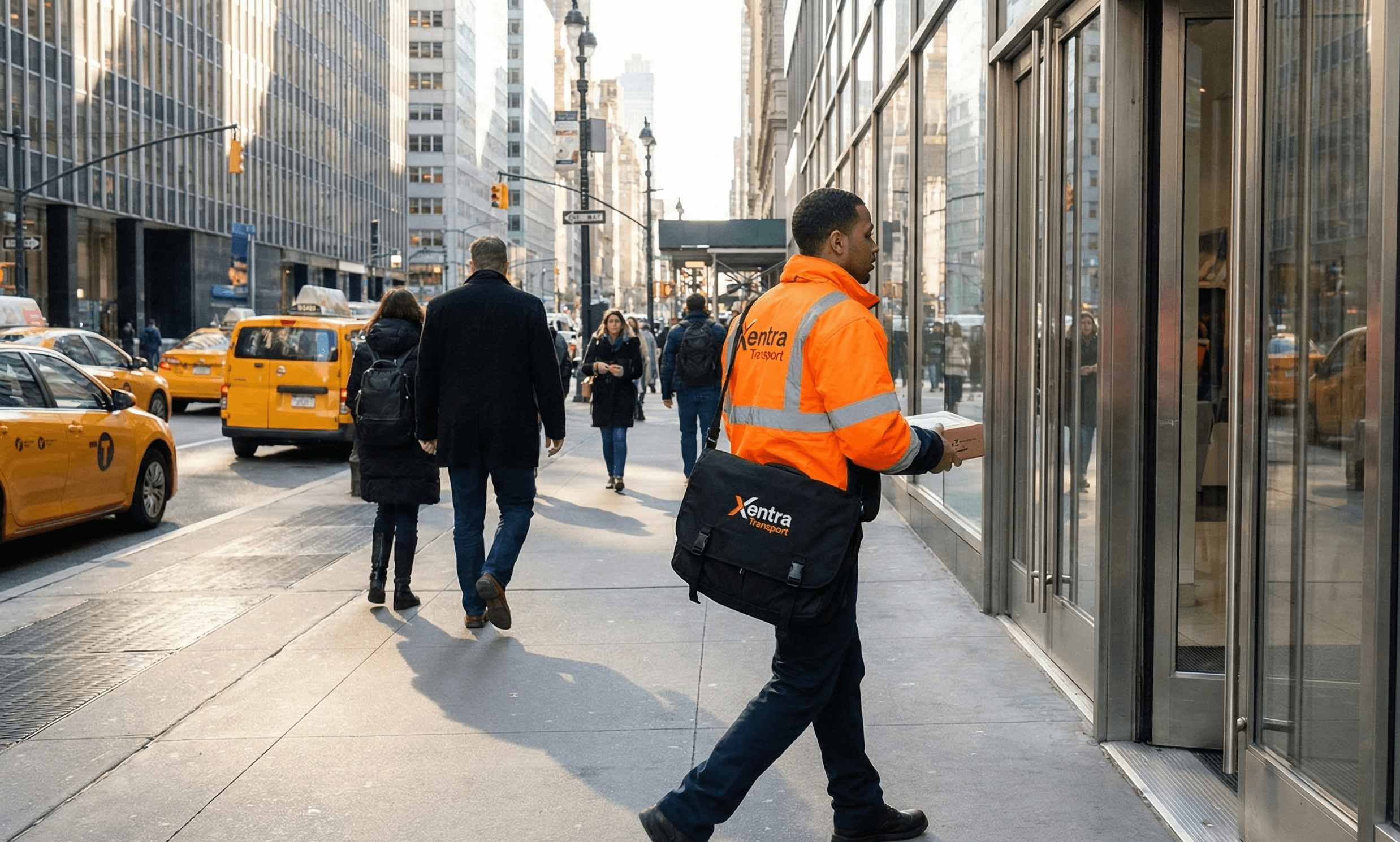
Hand delivery is a service level where the item is released only to a specific named individual, in person, against their signature. It is different from a standard signature-required delivery, which any adult at the address can sign for. If it matters who physically took the document, hand delivery is the only service that answers the question.
Most deliveries fail this test without anyone noticing. A parcel carrier's signature service is satisfied by a doorman, a receptionist, a mailroom clerk, or a neighbour. That signature proves the package reached the building. It proves nothing about whether it reached the person — and in a dispute, "the building signed for it" is exactly the answer that does not help you.
When Named-Recipient Delivery Is the Point
Legal notices and time-sensitive correspondence — demand letters, termination notices, cure notices, and anything where the date and recipient may later be contested
Wet-signature documents — originals that must be signed and returned the same day, where a copy or a scan is not acceptable
Confidential HR and personnel matters — separation packages, investigation materials, and anything that must not sit in an open mailroom
Board, deal, and diligence materials — documents that are restricted by name and should never be logged at a general reception
High-value and irreplaceable items — jewellery, passports, hard drives, original certificates, keys and access credentials
Regulated and patient-identifiable material — anything covered by our HIPAA-compliant delivery protocol, where an unattended handoff is itself the breach
Hand Delivery Is Not Process Service
Worth being precise about, because the two get conflated and the consequences of getting it wrong are real. A messenger performing hand delivery documents that a named person received an item. A process server performs legal service under the rules of court, and may execute an affidavit of service that a court will accept. Many things are properly served by a courier; some must be served by a licensed process server. Our guide to courier versus process server sets out where the line falls, and if your matter needs court filing rather than service, see how court filing delivery works. When in doubt, ask your counsel first — we would rather tell you we are the wrong service than take the booking.
The Proof You Get, and How the Handoff Is Controlled
The value of hand delivery is entirely in the record it produces. A delivery nobody can evidence is functionally the same as a delivery that did not happen.
What Is Captured on Every Hand Delivery
Named recipient confirmation — the messenger asks for the person by name and does not release to anyone else without your written authorisation
Signature captured at the point of handoff — with the recipient's printed name alongside it, not just a scrawl
Photo identification checked on request — where you specify it, the messenger verifies government photo ID before releasing
Time stamp and GPS location — recorded automatically at the moment of delivery, not entered afterwards; see how tracking and proof of delivery work
Photograph of the handoff or the sealed item — as instructed, without capturing anything confidential on the document face
A retained, retrievable record — so that six months later, someone asking who took delivery and when gets a name, a signature, and a timestamp rather than a shrug
Custody Between Pickup and Handoff
One messenger holds the item from collection to delivery — the same exclusive routing our STAT service uses. No batching with other jobs, no transfer between drivers, no depot, no overnight hold in a vehicle. Where the contents warrant it, the item travels under a numbered tamper-evident seal recorded on the manifest at both ends — the same discipline set out in our chain of custody guide. Messengers are employed, background-checked, and accountable to a named account contact; see quality assurance and licenses and credentials.
What Happens If the Recipient Is Not There
This is the part to agree before dispatch rather than during. The default on a hand delivery is simple: the messenger does not leave it. The item stays in custody and we contact you for instruction — wait on site, re-attempt at a stated time, deliver to an alternate named person you authorise, or return under seal. Nothing is released to a front desk to close out the job. See failed delivery and redelivery, and note that Manhattan commercial buildings frequently require a certificate of insurance and a named driver at security before a messenger reaches a floor at all — covered in our high-rise access guide.
Who Books Hand Delivery Most
Law firms and in-house legal teams for notices and originals; see law, media, and business offices. Banks, lenders, and accountants for closing files and signed instruments, through accounting and financial services. Real estate and title companies for closing packages, via same-day real estate courier. Insurance carriers and adjusters for claim files, through insurance and claims offices. And HR departments for anything that must not be discussed at a reception desk.
Need More Than A Messsenger?


Request A Quote Within Minutes
Pricing, and Why It Beats Certified Mail
Hand delivery is priced from the standard messenger rate with a supplement for named-recipient handling, ID verification, and the enhanced record. The vehicle depends on distance and size, exactly as it would on any other run.
Service | Coverage | Rate |
|---|---|---|
Hand delivery — bike (under 25 lbs) | Manhattan | From $55 |
Hand delivery — car | Same borough | From $95 |
Hand delivery — car | Cross borough | From $125 |
Hand delivery with photo ID verification | Any borough | From $135 |
Hand delivery under tamper-evident seal | Any borough | From $150 |
STAT hand delivery (30-60 min) | Manhattan / same borough | From $165 |
Wait-and-return (signature collected on site) | Any borough | From $185 |
Get an instant quote or call 877-709-2711 and tell us the recipient, the address, and whether you need ID verification.
Wait-and-Return Is the One Most People Forget
If the document has to come back signed, the messenger waits. They hand it over, the recipient signs while they are standing there, and the executed original returns to you the same afternoon instead of disappearing into someone's inbox for four days. For anything with a same-day closing or filing deadline, this single option removes the most common cause of the delay.
Against the Alternatives
Against certified mail. Certified mail produces a receipt and takes days, and the signature is frequently a mailroom or a household member. It is the right tool where a statute or contract specifies it. It is the wrong tool when you need the document in someone's hands this afternoon with a name attached.
Against parcel carriers. Their signature options are satisfied at the address, not the person, and their networks route through hubs with many handoffs. Neither is compatible with named-recipient custody.
Against gig apps. No verified identity on the driver, no commercial cargo cover, no chain of custody, and a photo of a doorstep as the proof. For a termination notice or an executed original, that is not a record you want to rely on.
Hand delivery pairs naturally with the rest of our messenger services: rush and STAT when the clock is short, bike messenger for speed across the Manhattan core, on-demand dispatch for the unplanned, and scheduled routes where named-recipient delivery is a standing requirement rather than a one-off.
Three combinations come up constantly. Several named recipients in one afternoon — a closing package going to four parties, or notices to a list of tenants — runs as a multi-stop route with a controlled handoff at every stop, which costs far less than booking each separately. Named-recipient delivery as a daily standard, common in legal and HR teams, belongs on a corporate interoffice route or with a dedicated messenger who already knows your buildings and your people. And handoffs that have to happen outside business hours — a document reaching an executive at home in the evening, or a recipient who is only reachable on a weekend — go through after-hours and overnight messenger service. Every run is covered by $1M-$5M cargo insurance with COIs issued at no charge, and building access is covered in our high-rise guide.
Read Testimonials


