
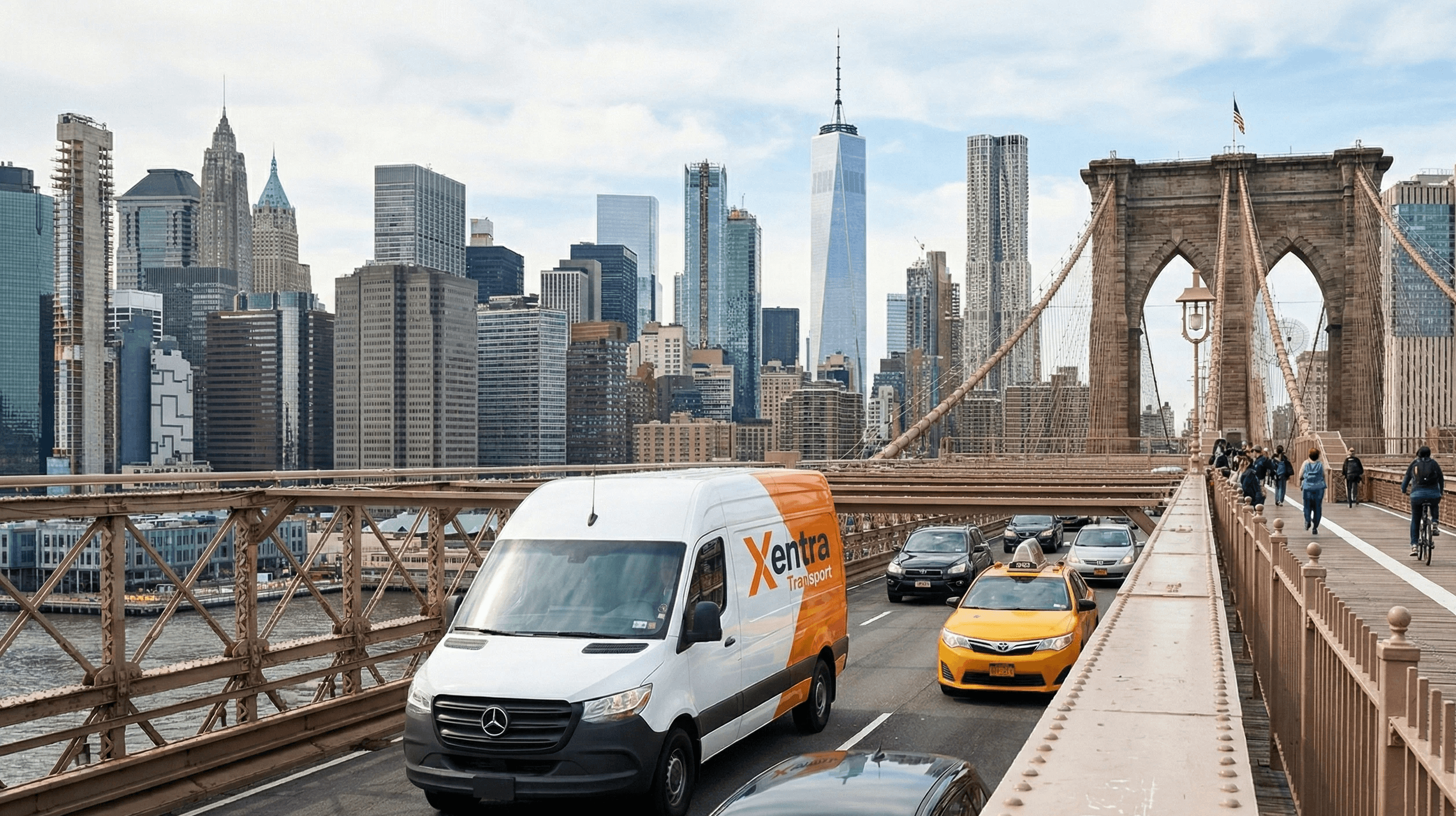
New York City receives 2.5 million packages every single day. That number was 1.1 million in 2017. It hit 1.8 million before the pandemic. Now it sits at 2.5 million — a 127% increase in seven years — and the infrastructure built to handle it is cracking.
FedEx and UPS were designed for a world where most packages went to commercial addresses during business hours. That world doesn't exist anymore. Today, one in three New Yorkers receives a package daily. 90,000 packages are stolen or lost in transit every day in NYC alone. Trucks crawl through Midtown at 7 miles per hour during peak hours — 50% slower than off-peak. And the businesses that depend on reliable delivery are paying more than ever for service that keeps getting worse.
This is why NYC businesses are switching to local courier services. Not because local couriers are trendy. Because the math stopped working for national carriers.
The Numbers Behind the Shift
The last-mile delivery market — the final leg from distribution center to destination — is now a $184 billion industry in the U.S., growing at 8.6% annually. By 2030, it will exceed $277 billion.
But here's the number that matters most to any business writing a check to FedEx: last-mile delivery now accounts for 53% of total shipping costs. That's up from 41% in 2018. More than half of what you spend on shipping goes to the last 10 miles — the part where a van sits in traffic on the BQE or a driver circles the block in SoHo looking for a loading zone.
McKinsey estimates that the total value of middle- and last-mile deliveries in the U.S. hit $485 billion in 2021, with $65-95 billion in waste generated at logistics handover points every year. That waste — failed deliveries, reroutes, sorting hub delays — is the tax businesses pay for using a system designed to move packages across the country, not across the borough.
For businesses shipping locally — a law firm sending contracts from Midtown to the Financial District, a wholesaler moving pallets from Newark to Brooklyn, a dental lab delivering crowns from Hackensack to Fort Lee — paying 53% of their shipping budget for a package to travel through a sorting hub in Memphis before coming back to the same metro area makes zero sense.
Same-Day Delivery Is the Fastest Growing Segment
The same-day delivery market hit $9.9 billion in 2024 and is projected to reach $29.8 billion by 2030 — a 20.6% compound annual growth rate. That's more than double the growth rate of standard delivery.
And it's not just consumers driving this. The B2B segment accounts for 61.5% of same-day delivery demand. Businesses are the ones who need a contract delivered for a closing by 3pm. Businesses are the ones who need a lab specimen transported within its viability window. Businesses are the ones whose production line stops when a replacement part doesn't arrive.
Over 51% of U.S. retailers now offer same-day delivery, and 65% plan to within two years. The expectation has shifted. Consumers now expect delivery within 3.5 days — two full days faster than when AlixPartners first measured it in 2012. And 25% say they'll shop somewhere else entirely if a retailer can't meet that window.
For B2B, the bar is even higher. When a law firm needs a filing at Kings County Courthouse before 4pm, "3-5 business days" isn't a delivery option. It's a malpractice risk.
NYC's Delivery Infrastructure Is Breaking
New York City was never built for 2.5 million daily packages. The streets were designed for horse carriages. The buildings were designed before elevators. The loading docks — where they exist — were built for an era when a few trucks per day was heavy traffic.
The NY State Comptroller found that 80% of NYC's daily packages now go to residential buildings, up from 40% pre-pandemic. E-commerce taxable sales grew 78% between 2019 and 2021. Local delivery service sales grew even faster — 149%.
What does this look like on the ground? 365 million tons of cargo pass through NYC annually, 89% carried by truck. Manhattan alone sees 125,621 truck crossings per day. Trucks make up 8-12% of all NYC traffic. And now, with congestion pricing in effect since January 2025, every truck entering Manhattan's Central Business District pays $14.40-$21.60 per trip during peak hours.
For a courier company running 10 deliveries a day into Manhattan, that's an additional $144-$216 in daily tolls. For a company running 20 trucks, it's roughly $135,000 per year in new costs that didn't exist 18 months ago.
National carriers pass these costs to the customer through surcharges. Local couriers who already have vehicles positioned inside the zone don't get hit the same way. This is one of the structural advantages that's accelerating the shift to local NYC courier services.
FedEx and UPS Are Losing Ground
This isn't speculation. It's showing up in the data.
FreightWaves reported in April 2025 that total U.S. parcel volume hit an all-time high of 23.8 billion packages in 2024 — up 50% since 2019. But UPS volume was flat at 4.8 billion. FedEx saw a marginal decrease to 3.4 billion. The growth went elsewhere.
Where? Amazon delivered 6.1 billion packages (up from 1.7 billion in 2019). And "other carriers" — including regional couriers, Walmart's delivery network, and independent operators — delivered 2.3 billion packages, up 44% year-over-year, generating $13 billion in revenue (up 48%).
Supply Chain Dive reported in February 2026 that shippers are actively seeking alternatives to FedEx and UPS. Companies like UniUni saw volume surge over 1,000% in a single year. Gofo now reaches over 70% of the U.S. population. As one logistics executive told Supply Chain Dive: there's a growing movement around not relying exclusively on the traditional big carriers.
AlixPartners found that 40% of shippers already shifted volume away from UPS and FedEx in the past year. Not considering shifting. Already shifted.
Meanwhile, both carriers raised rates 5.9% for 2026 — the third consecutive year at that level. Pre-pandemic, annual increases ran 3-4%. With surcharges, the actual impact is estimated at 8-12%. Residential delivery surcharges alone run $5.30-$5.65 per package.
For an NYC business shipping 50 local packages a week, that's $265-$282 per week just in residential surcharges — on top of the base shipping rate. A local same-day courier doesn't charge residential surcharges because there's no sorting hub, no residential vs. commercial classification, and no surcharge structure. The price is the price.
The Reliability Problem
Price is half the story. The other half is reliability.
During the 2024 peak season, FedEx's on-time delivery rate dropped to 91.8% — a 6.5-point decline from 98.3%. UPS fell to 96.5%. USPS hit 90.4%. One in ten packages through USPS didn't arrive on time during the busiest shipping period of the year.
The Better Business Bureau shows 13,365 complaints filed against FedEx in the last three years, with delivery issues accounting for 6,961 of them. UPS has 9,879 complaints in the same period with 4,153 delivery-related.
These numbers reflect a systemic issue, not one-off errors. When your package enters a national carrier's hub-and-spoke network, it travels from pickup → local hub → regional sorting center → destination hub → delivery truck. Every handoff is a failure point. Every sorting facility adds hours. Every transfer is an opportunity for a package to be misrouted, delayed, or lost.
A local courier eliminates every one of those handoffs. The driver who picks up your package is the same driver who delivers it. Direct. No hubs. No sorting. That's why businesses handling legal filings, medical specimens, trade show materials, and high-value merchandise are moving to local couriers — the margin for error is zero, and the national carrier system has too many failure points.
The Local Courier Advantage in NYC
The Bureau of Labor Statistics reports that the couriers and messengers industry now employs over 1,028,000 workers across 22,586 establishments. Employment in this sector is 27% higher than pre-pandemic levels — making it the only transportation industry that actually gained jobs during COVID's initial impact.
The BLS projects local messengers and local delivery as the fastest-growing employment segment within the entire transportation and warehousing sector through 2033. Delivery truck driver employment is expected to grow 9% over the next decade — much faster than the national average — with 183,800 annual job openings.
The growth isn't happening at FedEx and UPS. It's happening at local and regional operators. Companies that know their city, position their vehicles where the demand is, and deliver direct without routing through sorting hubs.
In New York City, that advantage is multiplied by the city's unique challenges:
Traffic that rewards local knowledge. A driver who knows that the Williamsburg Bridge is faster than the Manhattan Bridge between 3-5pm. That the BQE southbound bottleneck clears after the Atlantic Avenue exit. That the loading zone on Hudson Street in Hoboken is open before 9am but gone by 10. That Fort Lee cross-bridge runs should be timed between 10am and 2pm. National carrier drivers rotate routes and zones. Local courier drivers own their territory.
Building access that requires relationships. Delivering to a Hudson Yards office building requires a COI submitted 48 hours in advance, a specific freight elevator booking, and knowledge of which loading dock to use. Delivering to a Park Slope brownstone requires knowing that the cellar entrance on the side fits a dresser easier than the front stoop. National carriers leave packages at front desks. Local couriers deliver to the actual recipient — inside the building, on the correct floor, with a signature.
Pricing that makes sense for local routes. FedEx charges the same rate structure whether a package travels 5 miles or 500 miles. For a business in Manhattan sending a document to Jersey City — a 3-mile trip through the Holland Tunnel — paying the same surcharges and fuel adjustments as a cross-country shipment is irrational. A local messenger service charges based on distance and urgency. A 3-mile run costs what a 3-mile run should cost.
What NYC Businesses Actually Need
The businesses switching to local couriers aren't doing it because they read an industry report. They're doing it because their operations demand capabilities that national carriers structurally cannot provide:
Same-day and same-hour delivery. A law firm that needs a motion filed at Manhattan Supreme Court before the 4pm clerk deadline cannot use a carrier that offers "delivery by end of day." They need a bike messenger who picks up at 3:15 and delivers by 3:40. That's a fundamentally different service than what FedEx or UPS sell.
Direct chain of custody. When a hospital sends a blood specimen to a reference lab, the specimen has a viability window — often 60 minutes. It cannot sit in a sorting facility. It cannot be batched with other packages. It needs one driver, one vehicle, one direct route. That's STAT delivery, and it's a daily operational requirement for medical facilities across the city.
Freight without the freight broker. A wholesaler in Secaucus moving 3 pallets to a retailer in SoHo doesn't need a freight broker, a bill of lading, and a 3-day transit window. They need a box truck with a liftgate that picks up at 9am and delivers by noon. Local couriers with their own fleet handle this daily.
Building-specific expertise. Delivering a booth to the Javits Center requires navigating the marshalling yard on 12th Avenue, checking in with dock masters, and waiting for a call-up to the loading dock. Trade show logistics in NYC is not a delivery — it's a protocol. National carriers don't train drivers for individual venue procedures. Local couriers do, because they deliver to the same venues every week.
After-hours and weekend service. A production company shooting in DUMBO at 8pm that needs a replacement lens from a rental house in Chelsea cannot wait until Monday. A dental lab finishing a crown at 6pm for a patient appointment the next morning needs a driver tonight. National carriers close at 5pm. Local couriers operate 24/7 because emergencies don't follow business hours.
The Economics of Switching
The cost comparison isn't close. Here's what a typical NYC business spends on local delivery through national carriers versus a local courier:
Scenario: Law firm sending 10 documents per week across Manhattan and Brooklyn
National carrier (FedEx Priority Overnight): ~$25-40 per envelope × 10 = $250-400/week. Plus residential surcharges if any stop is residential. Delivery by 10:30am next day — not same day.
Local courier (scheduled messenger route): $250/day for a half-day route covering all 10 stops. Same-day delivery. Same driver every day who knows your offices, your clients, and your court filing procedures. Weekly cost: $1,250 — but covers unlimited stops during the route window, not per-package pricing.
For high-volume businesses, the dedicated messenger model — where a driver and vehicle are assigned to your business full-time — eliminates per-delivery costs entirely. You pay for the driver's time, not for each package. For businesses doing 20+ deliveries per day, this cuts delivery costs by 40-60% compared to national carrier per-package rates.
For one-off urgent deliveries, on-demand dispatch puts a messenger at your door in 15 minutes. No scheduling a pickup window. No waiting for a driver who's running 150 other stops. One driver. One package. Direct route.
Where This Is Heading
The Bureau of Labor Statistics projects delivery truck driver employment to grow 9% through 2033, with local messengers as the fastest-growing segment. The last-mile delivery market will exceed $258 billion by 2030. Same-day delivery will triple in size within five years.
The structural trends all favor local operators:
Congestion pricing makes hub-and-spoke more expensive. Every truck entering Manhattan's Central Business District now pays tolls that didn't exist before 2025. Carriers with sorting hubs outside the zone pay the toll on every delivery run. Local couriers with vehicles already positioned inside the zone absorb this cost once, not per-trip.
Consumer and business expectations keep accelerating. 76% of consumers say a positive delivery experience influenced their decision to repurchase from a brand. Nearly 50% stop buying from a brand entirely after a poor delivery experience. For B2B, the stakes are even higher — a missed delivery can cost a client relationship, a court case, or a patient's health.
National carriers keep raising prices. 5.9% rate increases for three consecutive years, with actual impact at 8-12% after surcharges. Every price increase pushes more local volume to local carriers who offer flat, transparent pricing without surcharge structures.
Package volumes keep growing. Pitney Bowes projects U.S. parcel volume will reach 30 billion packages by 2030. NYC's share of that will continue to outpace the national average. More packages means more congestion, more failed deliveries, and more demand for local couriers who can navigate the chaos.
The businesses that are already using local courier services — the law firms, medical labs, wholesalers, retailers, production companies, and architects — aren't going back to FedEx. They switched because the service is faster, the pricing is simpler, and the reliability is higher. Every business that hasn't switched yet is overpaying for worse service. The data is clear. The math is clear. The shift is already happening.
About Xentra Transport
Xentra Transport - Same Day Delivery provides same-day courier, messenger, freight delivery, and logistics services across New York City, New Jersey, Connecticut, and the tri-state area. We operate a fleet of cargo vans and box trucks with live GPS tracking, $1M-$5M cargo insurance, and professional, background-checked drivers. We serve over 500 businesses across Manhattan, Brooklyn, Queens, the Bronx, Staten Island, New Jersey, Long Island, and Westchester.
Services include document delivery, legal courier and court filing, medical courier, white glove delivery, large item and furniture delivery, trade show logistics, airport cargo pickup and delivery, marketplace furniture pickup, warehouse distribution, and event delivery.
$3/mile. $125 minimum. Get an instant quote or call 877-709-2711.