
What You Get on Every Delivery
Live GPS tracking
Live GPS tracking shared automatically with stakeholders
Signture & Proof of delivery
Photo + signature POD delivered same day
Trained & insured Couriers
W-2 or vetted IC couriers — never app-based gig drivers
Read More About Our Tracking Services
Banks and financial firms still move physical items every business day — deposit packages, original signature cards, wet-signature closing files, trust instruments, and audit workpapers. A financial courier run differs from ordinary delivery in its controls: numbered tamper-evident seals, dual control at both ends, background-checked drivers, and a retained, time-stamped proof of delivery.
The Check Clearing for the 21st Century Act — Check 21 — let banks exchange digital images instead of physical checks, and remote deposit capture pushed imaging out to the merchant counter. Between them they removed most of the overnight check transport that once defined bank courier work. What they did not remove is everything that cannot be reduced to an image.
Financial institutions and the firms around them still move physical items every business day: deposit packages from branches and merchant clients, original signature cards and account documentation, loan and mortgage closing packages that require wet signatures and notarization, trust and estate instruments, safe deposit inventories, board and audit materials, tax filings and workpapers between accounting firms and clients, and original securities and title documents that no imaging workflow accepts as a substitute. Each of these is either legally required in original form, or carries information whose exposure is the actual risk.
The second category is what changes the delivery requirements. A package of customer account documentation is a set of names, account numbers, and identifiers, and the institution handling it operates under the Gramm-Leach-Bliley safeguards framework and the third-party risk management expectations of its primary regulator — the OCC, the FDIC, the Federal Reserve, or the New York State Department of Financial Services, depending on charter. The courier is a vendor with access to nonpublic customer information, which means the delivery is a controls question, not just a transport question. Our accounting and financial services practice is built around that, and the same custody discipline is documented in our chain of custody guide.

Dual control at both ends. The item is prepared and sealed by one party and signed for by a named individual, not handed across a counter to whoever is nearest. For deposit and branch work, the seal number is logged on both sides so the chain is provable without opening anything. "Left at reception" is not a financial delivery — it is an incident report waiting to be written.
Tamper-evident sealing with recorded numbers. Numbered security bags or seals — serialized, single-use, and void-evident — with the number captured on the manifest at pickup and read back against it at delivery. If the number matches and the seal is intact, custody is clean. If it does not, the break is located precisely. This single control resolves the overwhelming majority of disputes about what was and was not in a package.
Vetted, background-checked, employed drivers. Not a gig app matching whoever is nearby. The person carrying customer documentation should be identifiable, trained, and accountable to the same vendor agreement your institution signed. Our quality assurance program and licenses and credentials pages document how we staff and audit this.
Time-stamped, GPS-backed tracking with retained proof of delivery. An auditor asking where a specific package was at 2:15 on a Tuesday six weeks ago should get an answer with a name and a signature attached, not a shrug. Retention of that record is part of the service, not an extra. See how tracking and proof of delivery work.
A defined exception procedure. Recipient unavailable, branch closed early, closing pushed an hour, address wrong. The rule for a financial run is that the item returns to a controlled location under seal rather than being left, re-attempted informally, or held in a vehicle overnight. Agree on that before the first run, not during the first exception. Our failed delivery guide covers the general mechanics.
One boundary worth stating plainly: bulk currency and cash-in-transit is armored-carrier work and belongs with a licensed armored operator. Document, deposit-package, and non-currency item transport is courier work. Do not blur the two, and be wary of any provider that offers to.
Learn More On Our Quality Assurance

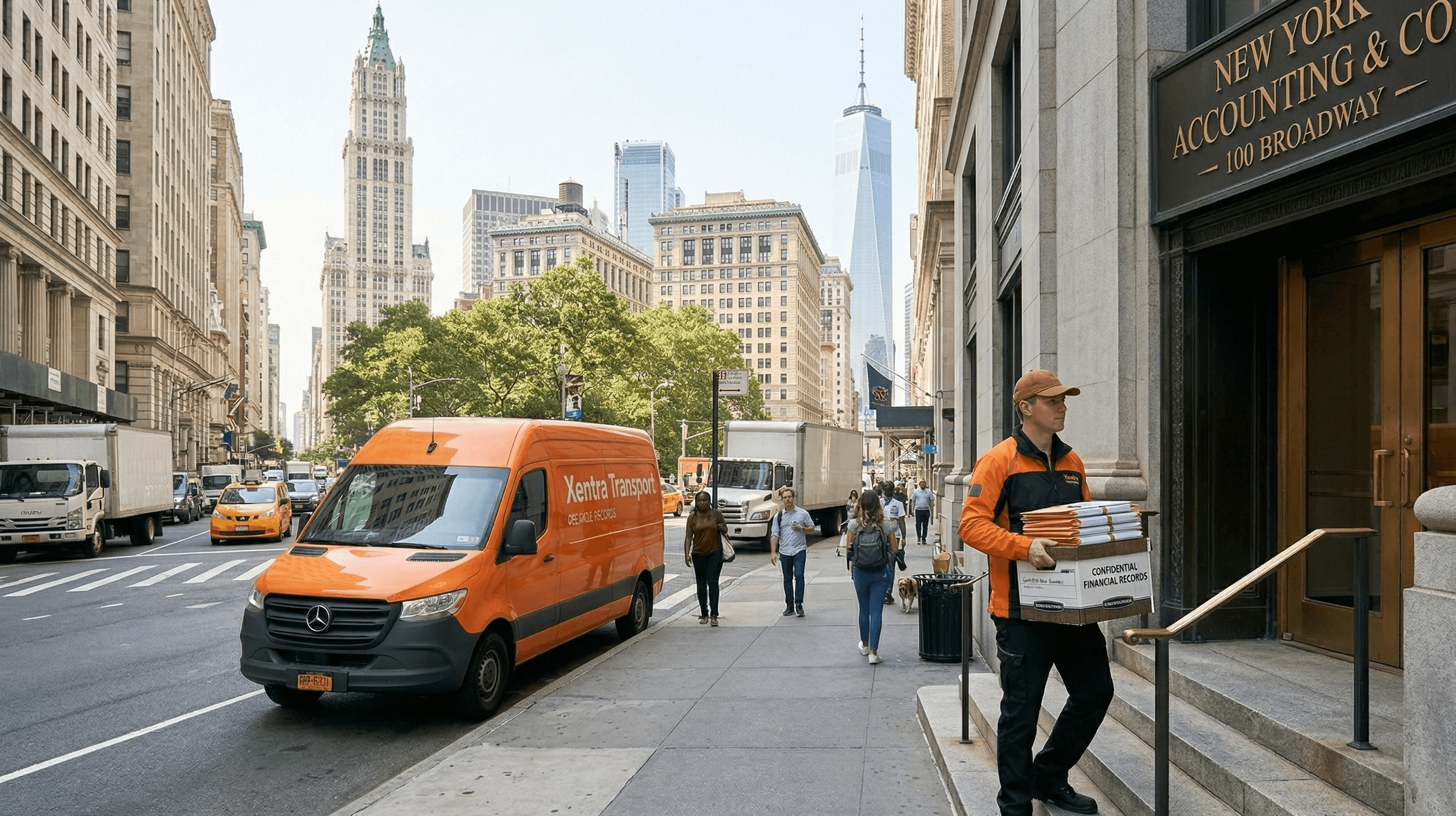

Daily branch and back-office routes. Standing runs between branches and operations centers on a fixed schedule are the backbone of this work — same driver, same window, same procedure every day, which is what makes exceptions visible immediately. Multi-stop routes across Manhattan, Brooklyn, Queens, and into New Jersey run through our recurring scheduled logistics and scheduled messenger service.
Loan and real estate closings. Closing packages moving between lender, title company, attorney, and closing table on a deadline that is measured in hours, where the wrong document at the table stops the transaction. This overlaps heavily with legal and real estate courier work; see our legal courier and court messenger service, our same-day real estate courier practice, and how court filing delivery works. Straight document runs go through document delivery service, or document delivery in NJ for the Hudson County back offices. The Financial District, Midtown law and lender corridor, and Jersey City back-office campuses generate most of this volume.
Accounting and audit season. Workpapers, source documents, and signed returns moving between firms and clients, concentrated brutally around filing deadlines. Firms that set up standing pickup windows in advance ride those weeks far better than firms dispatching ad hoc at 6 p.m. on the fifteenth.
Trust, estate, and fiduciary documents. Original instruments moving between counsel, trustee, and beneficiary, frequently with a signature requirement and no acceptable substitute for the original. Same custody discipline as high-value goods, different cargo.
Insurance and claims operations run a parallel version of this. Claim files, adjuster reports, medical records supporting a claim, and settlement packages carry the same combination of deadline pressure and confidential personal information, and they move between carriers, independent adjusters, counsel, and medical providers across the region — see our insurance and claims offices practice. Corporate and suburban back-office volume runs north to White Plains and the Westchester corridor and east into Fairfield County on the NY-to-Stamford and NY-to-Greenwich routes.
Xentra Transport runs secure financial and document courier service across NYC, New Jersey, Westchester, Long Island, and Connecticut, including the NY-to-NJ back-office corridor and the Philadelphia and Washington DC runs. Sealed custody, named recipients, retained proof of delivery, and vendor documentation your compliance team can actually file. Call 877-709-2711 or open an account to set up standing routes.
See Why They Choose Us
Branch, Back Office, Closing Table — Under Seal and Under Signature
Request Financial Courier Quote
Meet Your Industry Needs Call Us


