
What You Get on Every Delivery
Live GPS tracking
Live GPS tracking shared automatically with stakeholders
Signture & Proof of delivery
Photo + signature POD delivered same day
Trained & insured Couriers
W-2 or vetted IC couriers — never app-based gig drivers
Read More About Our Tracking Services
In New York, alcohol delivery flows through a licensee. A licensed retailer may deliver using its own employees or through agents acting under its license and supervision — the courier does not hold the authority, the license does. Every handoff requires an in-person check of government photo identification showing the recipient is twenty-one or older.
For nearly every other commodity, the law cares about what was sold and to whom. For alcohol, the transportation and the handoff are themselves regulated activities, governed in New York by the Alcoholic Beverage Control Law and administered by the State Liquor Authority. That single difference is why a courier arrangement that would be routine for any other product needs to be structured deliberately here.
The core principle in New York is that the sale and delivery of alcoholic beverages flow through a licensee. A licensed retailer may deliver to customers, and it may do so using its own employees or through agents acting on its behalf under its license and its supervision — but the license is what authorizes the transaction, not the courier. An unlicensed party cannot simply take custody of alcohol and sell or deliver it independently. Structuring matters: who holds the license, whose agent the driver is, how the transaction is recorded, and who bears responsibility at the door are all questions to answer before the first run, with your counsel or directly with the SLA.
There is also a second, separate track for direct-to-consumer shipping — a winery shipping to a New York consumer, for example — which requires its own permit and works under different conditions than local retailer delivery. And New Jersey has its own regime entirely; the state's Division of Alcoholic Beverage Control administers a Third-Party Delivery Permit, established by Special Ruling 2022-15, for operators delivering on behalf of licensees, which means a run that crosses the Hudson may touch two different regulatory frameworks. Do not assume New York and New Jersey rules mirror each other. They do not.
This guide explains how the operational side works. It is not legal advice, and the rules change — confirm current requirements with the New York State Liquor Authority, the New Jersey Division of Alcoholic Beverage Control, or your attorney before you set up a delivery program.

Age verification, every time, in person. Alcohol may only be handed to someone twenty-one or older, and the driver checks a valid government-issued photo ID at the door. Not the name on the order — the person physically accepting. There is no version of this that works by leaving a case in a vestibule, with a doorman, or outside an apartment door. "Leave at door" does not work for alcohol, because there is no way to verify age without a person present — and a provider that offers it is creating exposure for the licensee whose name is on the sale.
No delivery to a visibly intoxicated person. The same standard that applies at a bar applies at the doorstep. A driver who has any doubt refuses the handoff and the order returns. That has to be a trained decision the driver is backed on, not one they make alone under pressure at the door.
Record the handoff. Signature, time stamp, and a record that ID was checked. If a compliance question arises later — and in this category it does — the record is the defense. Our tracking and proof-of-delivery system captures signature, time, and geolocation on every drop.
Train and supervise the driver. Recognizing valid identification, spotting altered or out-of-state IDs, handling a refusal calmly, and knowing when to return the order are trained skills. This is a strong argument for an employed, vetted driver workforce over app-dispatched strangers — see how we staff in our quality assurance and licenses and credentials pages.
Know what else is restricted. Alcohol is one of several categories that carry transport restrictions rather than simply being awkward to ship — our guide to what cannot be couriered covers the rest, and it is worth reading before you assume a courier can carry something. Handle the product properly on the way. Wine is temperature-sensitive; a case left in a closed van in July is a case of cooked wine, and heat damage is not visible until it is opened. Kegs are heavy, pressurized, and need upright transport and a liftgate at most receiving points. Glass needs case-level padding and secured stacking. See our temperature-controlled delivery guide for the climate side.
Learn More On Our Quality Assurance

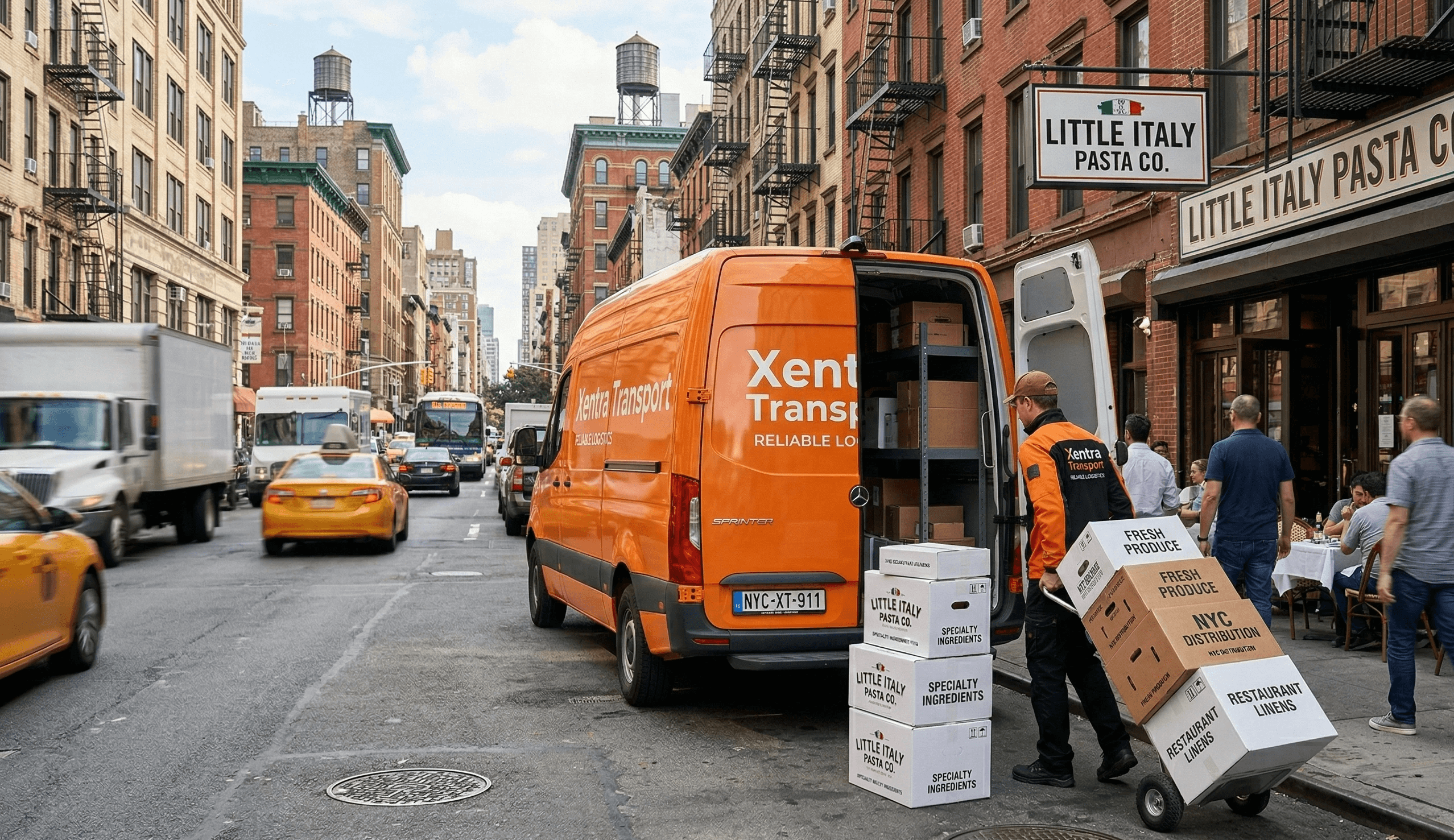

Retailer-to-consumer delivery. Wine shops and liquor retailers delivering to customers within their permitted area, typically same-day, structured so the delivery is made by or on behalf of the licensee with age verification at the door. This is the highest-volume category and the one most exposed to compliance error, because the volume is retail-scale and the handoff is residential. The consequences land on the licensee rather than the courier: the SLA can suspend, cancel, or revoke a license and impose civil penalties for improper delivery, which is why retailers structure these arrangements carefully rather than informally.
Wholesale and distributor resupply. Cases and kegs moving from distributors to restaurants, bars, hotels, and event venues, usually into a back-of-house receiving window with a narrow time slot. This is the bread-and-butter of beverage distribution delivery — and where an emergency mid-service resupply run is worth many times its cost to the venue. See our restaurants and food service and hotels and hospitality practices.
Event and catering bar logistics. Bar stock, glassware, ice, and equipment moving to a venue for a specific call time, then the unopened stock and rentals coming back after strike. Venue access rules, dock windows, and certificates of insurance apply exactly as they do for catering and floral. Handled through our event delivery service and wedding logistics.
Corporate gifting and holiday programs. Bottle gifting to clients and staff, concentrated hard into December, with the same age-verification requirement at every single door — which is what makes it operationally heavier than ordinary gift delivery. Plan it around the constraints in our holiday and peak season guide.
Distribution volume behind the retail tier. Most alcohol in the city moves wholesale before it ever moves retail — importer to distributor, distributor to licensed retailer and on-premise account — which is standing route work rather than on-demand dispatch. See our wholesale distributors practice and the APE Water beverage delivery case study for how a recurring beverage route is actually structured. Retail delivery density concentrates in the neighborhoods with the most licensed shops and the most walk-up buildings — West Village, Park Slope, Upper West Side — and summer pushes case volume east on the NY-to-Hamptons route.
Xentra Transport works with licensed retailers, distributors, restaurants, hotels, and event operators across Manhattan, Brooklyn, Queens, the Bronx, Staten Island, and New Jersey. Temperature-appropriate vehicles, liftgate equipment for kegs and bulk cases, trained drivers, signature and ID capture at the door, and delivery structured to sit properly under your license. Call 877-709-2711 and tell us how your program is set up.
See Why They Choose Us
Licensed, Compliant Beverage Delivery Across NYC and NJ
Get a Beverage Delivery Quote
Meet Your Industry Needs Call Us


