
What You Get on Every Delivery
Live GPS tracking
Live GPS tracking shared automatically with stakeholders
Signture & Proof of delivery
Photo + signature POD delivered same day
Trained & insured Couriers
W-2 or vetted IC couriers — never app-based gig drivers
Read More About Our Tracking Services
A $40,000 painting and a 3-pound box of office supplies travel through the same FedEx and UPS network the same way. Same conveyor belts, same sortation hubs, same trucks loaded floor-to-ceiling. The "fragile" sticker is a polite suggestion the system doesn't enforce. The handling protocol is whatever the package handler at the sortation hub feels like doing in the 8 seconds your package spends in their hands. That's why art ships on a different network entirely — not because galleries and collectors are precious, but because the insurance math doesn't work otherwise. A standard parcel carrier's declared-value insurance caps in the low thousands and excludes art-specific damage modes (frame separation, surface abrasion, climate exposure, vibration damage to oil paint, light exposure to paper-based work). The first time a piece arrives damaged, the carrier reimburses the declared value minus their exclusions, and the actual loss falls on the gallery, the artist, or the collector.
Same-day art delivery operates on a different model. One driver, one vehicle, point A to point B, the work travels alone or with carefully-selected other works that won't damage it in transit. No conveyor belts. No sortation hubs. No truck stacked with parcels of every size and weight. No automated handling. Condition documentation at pickup — photos of the work in its packing, photos of the seal on the crate, signed condition report at point of origin. Same condition documentation at delivery — photos at unpacking, condition verification by the receiver, signed acknowledgment of the condition at handoff. The full chain of custody is photographed, time-stamped, and audit-ready, which is what your insurance carrier actually requires when you make a claim. Detail at our white-glove delivery service and the specialized delivery framework.
Xentra Transport runs same-day art delivery across NYC and the broader tri-state for galleries, museums, artists, dealers, and private collectors. Volume corridors include the Chelsea gallery district (West 20s and 30s), SoHo dealerships, the Lower East Side gallery cluster around Orchard and Rivington, the Williamsburg, Bushwick, and Greenpoint studio belt, the DUMBO arts district, the Long Island City studio cluster, the Upper East Side gallery and private collection corridor, and the cross-Hudson route to NJ collectors and storage facilities through the NY-to-NJ corridor. This guide walks through prep, packing, condition documentation, vehicle selection, and the practical mechanics of same-day art delivery — including the parts that separate a successful delivery from a five-figure damage claim. For broader fragile-item handling protocols, see our how to ship fragile items guide.

Step 1: Document the work's condition at pickup. Photograph the front, back, and all four edges of every piece before packing. Note any pre-existing condition issues — surface scratches, frame chips, hairline cracks in glaze, foxing on paper — with detailed photos and a written condition report. This becomes your insurance position. If damage occurs in transit, the condition report at pickup is what proves the damage happened during shipping rather than before. Step 2: Protect surfaces. Glassine paper or acid-free tissue across the surface of paintings (especially oil and acrylic, where contact damage is permanent). Bubble wrap or padded blankets around the perimeter. Corner protectors on framed work — foam or padded card stock that prevents corner abrasion against the inside of the crate or vehicle wall. Acrylic glazing or museum glass should travel with surface film attached if available; standard glass framing should be cross-taped on the surface to prevent shatter spread if the glass cracks (this also makes broken glass cleanup much faster).
Step 3: Crate or pad-wrap. For high-value works, museum-quality crating is the standard — typically a wooden crate with foam-lined cavities sized exactly to the work, sealed with screws (not nails, which require pry-bar removal that risks damaging the crate). For mid-value works in transit between gallery and studio, blanket-wrap with strapping is acceptable. For lower-value works traveling short distances, padded transit bags or bubble-wrap-and-cardboard packaging works for the same-day window. Sculpture requires custom cradling — foam cavities, securing straps, weight-balanced positioning. The vehicle matters here. A standard cargo van handles framed paintings up to about 60 inches; a Sprinter van or 16-ft box truck handles larger works. Large item delivery coordinates the right vehicle. Step 4: Strap and secure inside the vehicle. Vertical positioning where possible (paintings travel best on edge, not flat). Padding between works to prevent contact. Securing straps that anchor the work to the vehicle's tie-down points — not just to other crates. The driver should be trained to check securing every 30 minutes on longer runs.
Step 5: Condition documentation at delivery. Photo of the unopened crate or wrap at the destination. Recipient signature acknowledging the condition matches the pickup-side documentation. Photo of the work as it comes out of the packing, with the recipient present. Signed condition acceptance at the receiving end. This entire chain — condition photos, driver custody log, GPS-tracked transit, recipient signature, condition acceptance — is what your insurance carrier reviews when assessing a claim. Without it, the claim becomes a "he said, she said" between gallery and shipper. With it, the claim resolves on the documented evidence. Live tracking and PoD framework at our delivery tracking guide; chain-of-custody specifics relevant to high-value transport in our chain-of-custody guide (the same protocols apply to art).
Learn More On Our Quality Assurance

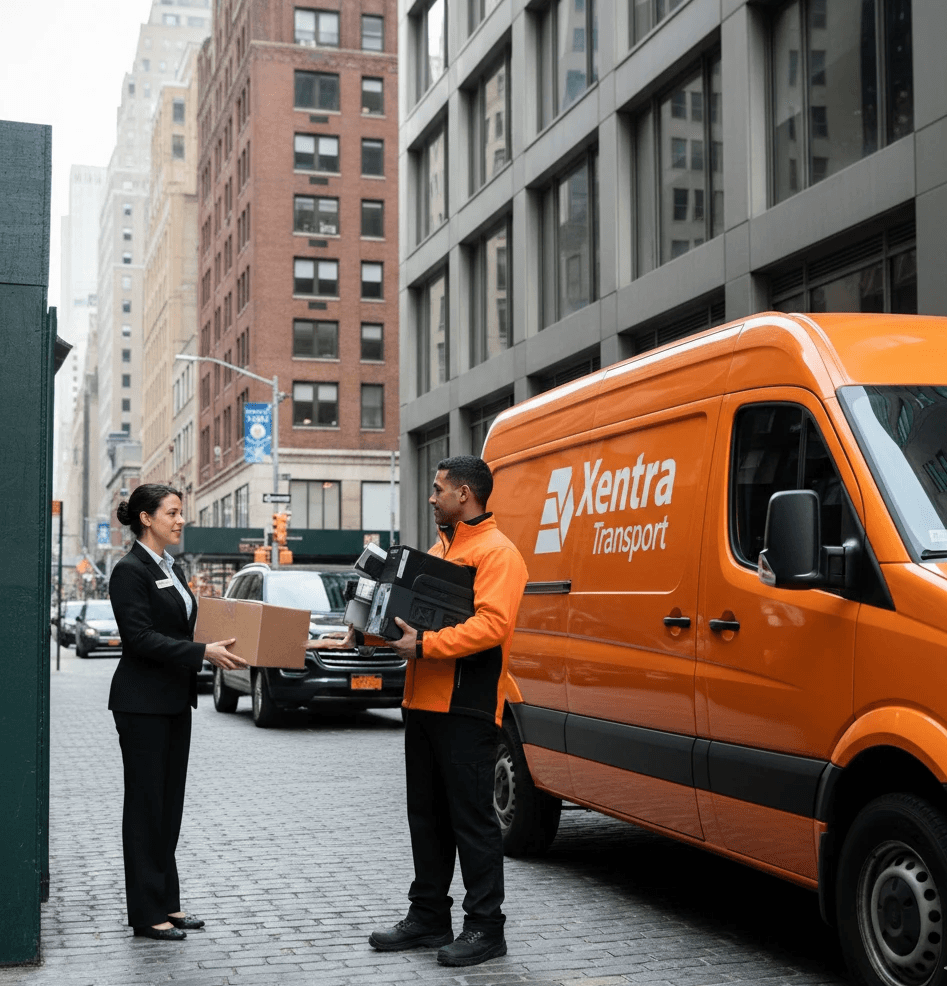

Chelsea gallery district to private collector deliveries. The Chelsea galleries (David Zwirner, Pace, Gladstone, Marlborough, Hauser & Wirth, and the broader gallery footprint along West 19th-29th) ship daily to private collectors across Manhattan, Brooklyn, and the broader NY/NJ collector base. Same-day runs typically dispatch in 60-90 minutes and arrive within 2-3 hours including white-glove unpacking. SoHo and Lower East Side gallery deliveries. The SoHo dealerships and the LES gallery cluster around Orchard and Rivington run smaller-scale same-day deliveries, often to clients within Manhattan or to short-stay storage facilities. Brooklyn studio pickups. Active artist studio communities in Williamsburg, Bushwick, Greenpoint, DUMBO, and the Sunset Park Industry City complex generate continuous same-day pickup volume — works moving from studios to galleries for shows, to storage between exhibitions, to art handlers for crating, and to collectors after sales. Long Island City studios in LIC connect closely to the Manhattan gallery network on a 30-45 minute cross-river run. Cross-Hudson deliveries to NJ collectors and storage. The NY-to-NJ corridor handles continuous flow to NJ-side collector residences, particularly through Bergen County (the affluent Saddle River, Alpine, Englewood collector belt), the Princeton corporate-collector zone, and the storage facility cluster across Secaucus and North Bergen.
Specific use cases: art-fair load-in and breakdown (Frieze NYC, the Armory Show, NADA, Independent — coordinated through our trade show delivery service with appropriate marshaling-yard procedures); estate and collection management deliveries (works between collector residences, storage facilities, conservation studios, and galleries during estate dissolution or collection rebalancing); auction house pre- and post-sale logistics (works to and from Sotheby's, Christie's, Phillips, Bonhams, Doyle for inspection, photography, sale day, and post-sale delivery to buyers); museum-to-gallery loans (when a museum lends to a gallery exhibition or vice versa); conservation studio transport (works to and from conservation specialists for treatment, often with specific climate or vibration constraints).
Vehicle and crew sizing. Small framed work under 36 inches: cargo van with single driver. Medium framed work, 36-72 inches, or single sculpture: Sprinter van with single or two-person crew depending on weight and stair access at destination. Large works over 72 inches, multiple framed pieces, or whole-collection moves: 16-26 foot box truck with two-person white-glove crew, securing straps, blanket wrap, and inside-placement protocols. Two-person crew is required for any work over ~75 lbs that requires stair handling at the receiver, for sculpture requiring upright stabilization during install, and for any whole-show installation where positioning matters. Building Certificates of Insurance issued at no charge — required for most Class A buildings in Manhattan, the Hudson Waterfront commercial corridor, and gallery district landlord properties. After-hours and weekend art deliveries through our overnight courier service; coordinated chain-of-custody documentation for fine art shipments through our chain-of-custody framework. For broader white-glove blog context across NYC and NJ, see our white-glove delivery blog.
See Why They Choose Us
Same-Day Art Delivery Across NYC: Chelsea, SoHo, LES, Brooklyn Studios
Book Art Courier
Meet Your Industry Needs Call Us


