
What You Get on Every Delivery
Live GPS tracking
Live GPS tracking shared automatically with stakeholders
Signture & Proof of delivery
Photo + signature POD delivered same day
Trained & insured Couriers
W-2 or vetted IC couriers — never app-based gig drivers
Read More About Our Tracking Services
Shipping jewelry in NYC means moving it on a secure same-day courier rather than a parcel network. One vetted driver holds custody end to end, the item travels under a numbered tamper-evident seal against an itemized manifest, and it is released only to a named recipient who presents photo identification.
Open the terms of service for any national parcel carrier and look for jewelry. You will find it in two places: the prohibited items list and the limited-liability list. Loose gemstones, industrial diamonds, and bullion are generally not accepted at all. Finished jewelry that is accepted usually carries a declared-value ceiling in the hundreds of dollars, not the tens of thousands — meaning a ring worth $18,000 that disappears in a sortation hub is reimbursed at a fraction of its value, if at all. Check your carrier's current published terms before you hand anything over the counter; these limits change and they are enforced at claim time, not at drop-off.
The second problem is structural. A parcel network is designed for anonymity and volume: a package changes hands a dozen or more times between origin and destination, passes through automated sortation, and sits overnight in facilities where the individual handling it has no idea what is inside and no personal accountability for it. That is the correct design for a box of catalogs. It is the wrong design for a memo of loose stones traveling from West 47th Street to a Madison Avenue client, or a consignment moving from a showroom to an auction preview.
Secure transport is built the opposite way. One vetted driver takes custody, the item never leaves that driver's control, and every transfer is signed and time-stamped. The route is direct. There is no hub, no overnight hold, no unattended vehicle. For dealers on 47th Street, for watch retailers, for estate attorneys moving inherited pieces, and for private collectors, that is the difference between a shipment and a liability. See how we structure it on our specialized delivery service and our jewelry and high-value goods practice.

Step 1: Do not describe the contents on the outside. Nothing on the exterior packaging should indicate value — no store name, no "fragile jewelry," no branded tape. The outer container should look like any other business parcel. Internal documentation identifies the contents; external labeling does not.
Step 2: Inventory and photograph before sealing. Itemize what is going: piece description, metal, stone weight and count, serial or movement number for watches, and a stated value per line. Photograph each item and the packed container before it closes. This inventory is what an insurer works from, and it is what makes a discrepancy at the receiving end provable rather than arguable.
Step 3: Use tamper-evident sealing. A numbered security seal or tamper-evident bag with the seal number recorded on the manifest. The receiving party checks the number against the paperwork before opening. If the number matches and the seal is intact, custody is clean end to end. If it does not, you know exactly where the break occurred.
Step 4: Confirm your insurance actually covers transit. A jewelers block policy, a dealer's floater, or a fine-arts rider typically governs goods in transit, and most contain conditions — carrier requirements, signature requirements, unattended-vehicle exclusions. Read those conditions before you book, not after a loss. Note that a certificate of insurance proves a courier carries liability coverage for building access; it is a separate instrument from cargo or specie coverage on the goods themselves. Our cargo insurance and declared value guide explains the distinction in full.
Step 5: Lock down the handoff. Name the authorized recipient in advance and require photo identification at delivery. No "leave with the receptionist," no lobby drop, no signature by whoever happens to be at the desk. For consignment and memo movements, the signed delivery receipt referencing the seal number and inventory closes the loop.
Learn More On Our Quality Assurance

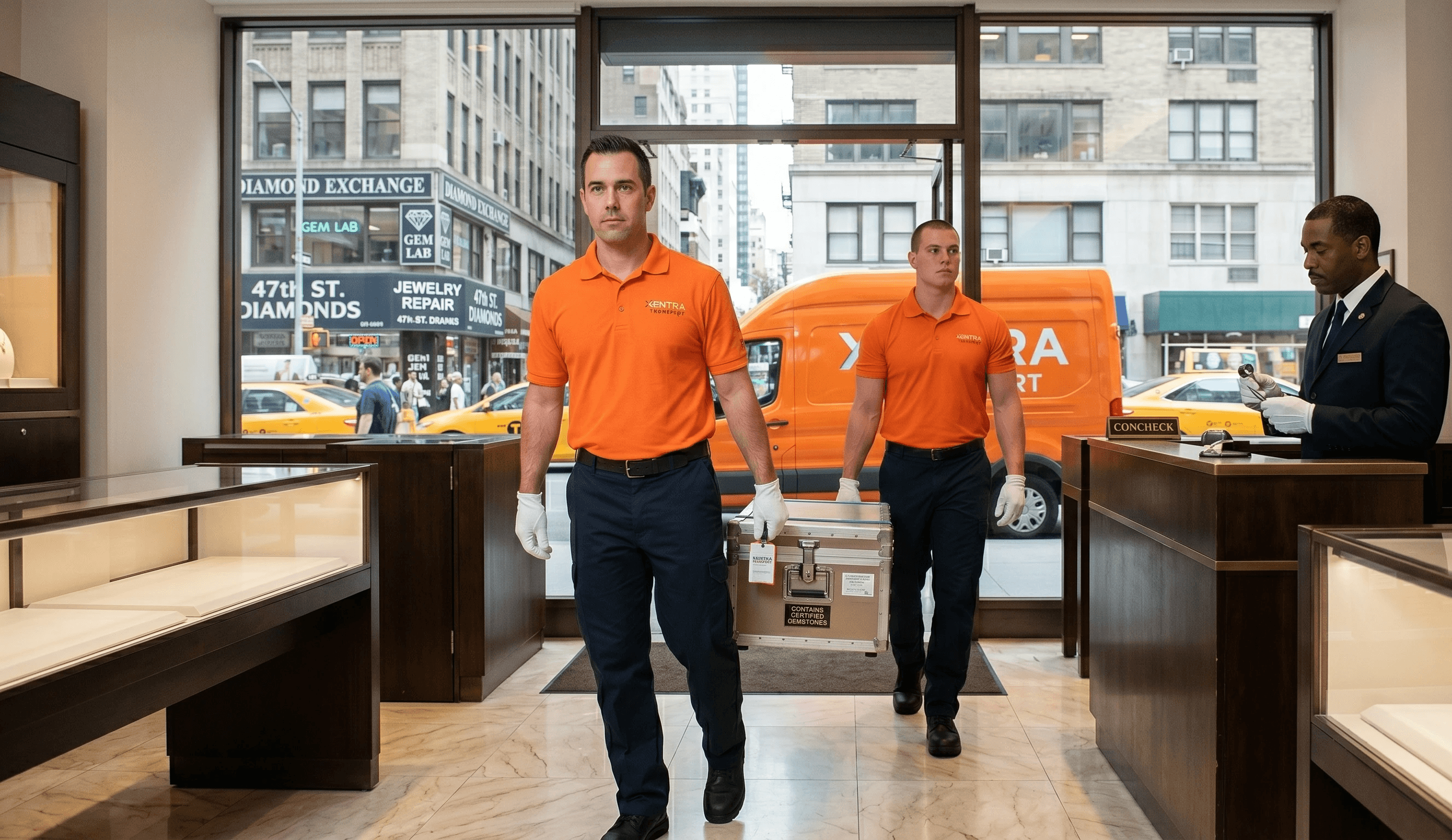

West 47th Street. The block between Fifth and Sixth Avenues is one of the densest concentrations of jewelry trade anywhere, and it operates on trade hours, exchange booths, and memo movements between dealers who may be four floors apart in different buildings. Much of the daily volume is short-hop: a stone going out to a setter, a piece going to a gemological lab for certification and coming back, a memo out to a retailer for a client viewing. These runs are fast, which is exactly why they get handled casually — a stone leaves on a verbal memo, nobody signs anything, and a week later two parties remember the handoff differently. Building access on the block is tight — many offices are buzz-in only, and lobby security frequently requires the driver to be named in advance.
Common corridors we run. Diamond District to Upper East Side and Madison Avenue retail; short hops within Midtown and down to the Financial District for vault, bank, and appraisal appointments; 47th Street to the auction houses and preview spaces for consignment intake; showroom to SoHo and Tribeca boutiques; Manhattan to vault and safe-deposit facilities; and the cross-Hudson run through the NY-to-NJ corridor to Bergen County and Secaucus storage. Watch service and repair movements between retailers and authorized service centers run continuously, as do estate pieces moving between attorneys, appraisers, and family members.
Adjacent categories that move the same way. Fine art, antiques, and collectibles travel on the same custody model — see our art delivery service and our galleries and auction houses practice. When a loss does occur, the documentation discipline is the same one our insurance and claims offices clients work from every day. For a piece that has to reach a client, a show, or a lab across town within the hour, rush and STAT messenger dispatch is faster than a van; for anything leaving the country, our international courier service covers the leg a local run cannot.
What we will and will not do. Xentra Transport moves jewelry, watches, precious-metal goods, and other high-value items under signature with named-driver custody, tamper-evident sealing, and photographic proof of delivery. Bulk currency and cash-in-transit is armored-carrier work and belongs with a licensed armored operator, not a courier. For high-value items requiring inside placement, installation, or two-person handling — display cases, safes, exhibition fixtures — our white-glove delivery crews handle it, and building certificates of insurance are issued at no charge. Tell us the item, its stated value, and the two addresses on 877-709-2711, and we will tell you what the run needs before you commit to it.
See Why They Choose Us
Diamond District, Showroom, or Vault — We Move It Under Signature
Get a Secure Quote
Meet Your Industry Needs Call Us


