
What You Get on Every Delivery
Live GPS tracking
Live GPS tracking shared automatically with stakeholders
Signture & Proof of delivery
Photo + signature POD delivered same day
Trained & insured Couriers
W-2 or vetted IC couriers — never app-based gig drivers
Read More About Our Tracking Services
Sample trafficking is the continuous circulation of a limited set of garments and accessories between showroom, PR agency, stylist, photo studio, and editorial office. There is usually one sample, it moves same-day, it travels on hangers rather than folded in a box, and it is itemized on a pull sheet at both the outbound and the return leg.
The circuit is longer than most people outside the industry realise: showroom, PR agency, stylist, photo studio, editorial office, celebrity fitting, and back to the showroom before the next request comes in. There is usually one sample. It is often the only one in the country. And three people want it on the same Thursday.
That scarcity is what makes the logistics hard: the asset is irreplaceable on the timeline that needs it, and every movement is a custody event with a deadline attached. A sample cannot be folded into a box and left in a lobby — it arrives on a hanger, in a garment bag, steamed and ready to shoot, or the receiving stylist loses an hour they do not have. It cannot be untracked, because a missing sample from a designer's mainline collection can easily run into five figures and costs you the relationship with the brand. And it cannot be slow, because the entire calendar runs on same-day turnarounds between the Garment District, downtown studios, and Brooklyn shoot spaces.
The Garment District itself — broadly West 34th through 42nd Streets between Fifth and Ninth Avenues, depending on whose boundary map you use — still concentrates showrooms, pattern makers, sample rooms, trim suppliers, and production offices in a few dense blocks. Much of the daily volume is short-hop and vertical: a pull going four blocks and eleven floors up, a fitting sample crossing the street, a trim delivery to a sample room with a production deadline that afternoon. Fast, small, constant, and entirely dependent on the courier knowing how buildings on those blocks actually work. See our fashion courier service and fashion brands, showrooms, and agencies practice.

Step 1: Build a pull sheet before the driver arrives. Every piece leaving the showroom gets a line: style name, style number, size, color, and condition notes. The driver signs against the count, not against a vague "one rack." When the samples come back, they check in against the same sheet. Most sample losses are not theft. They are pieces that went out on a pull nobody itemized and came back to a rack nobody reconciled.
Step 2: Send it the way it needs to arrive. Tailored garments, gowns, outerwear, and anything that creases travel hanging in garment bags on a rolling rack or a rail-equipped van. Knitwear and jersey travel flat and folded to avoid shoulder distortion. Shoes travel in boxes with tissue. Jewelry and watches travel under separate secure protocol — see our high-value shipping guide. Handbags travel stuffed and dust-bagged. Tell the courier which of these applies before dispatch, because the vehicle and equipment differ.
Step 3: Confirm the receiving end can actually take it. A photo studio in a loft building with a single service elevator and a shoot in progress is not a "leave at the desk" destination. Name the recipient — the stylist, the market editor, the studio manager — and confirm they are on site. Manhattan commercial buildings often require a certificate of insurance and a named driver at the security desk; our high-rise access guide explains what those buildings ask for.
Step 4: Book the return at the same time as the delivery. Samples that go out without a scheduled return are samples that sit in a studio corner for two weeks while the showroom fields requests for them. The return leg is the part that gets forgotten and the part that costs money. Standing return pickups after shoots, and end-of-day sweeps during market weeks, solve most of it. Our recurring scheduled logistics covers standing runs.
Step 5: Keep proof on both legs. Photo at pickup showing the rack or bags as loaded, signature at delivery from the named recipient, photo at return check-in. That record is what settles a "we sent four, we received three" conversation in ten seconds instead of ten emails. See how delivery tracking and proof of delivery work.
Learn More On Our Quality Assurance
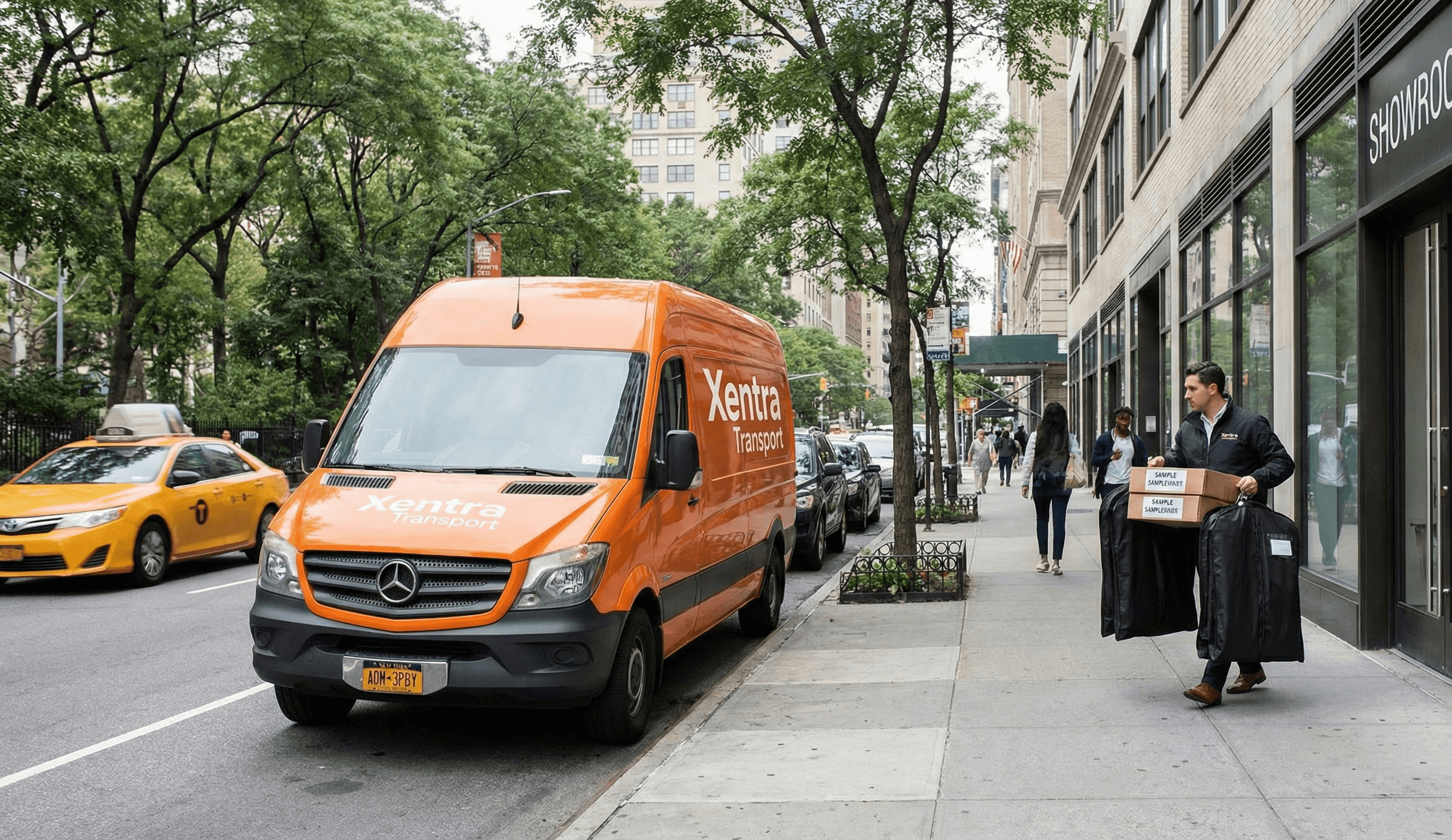
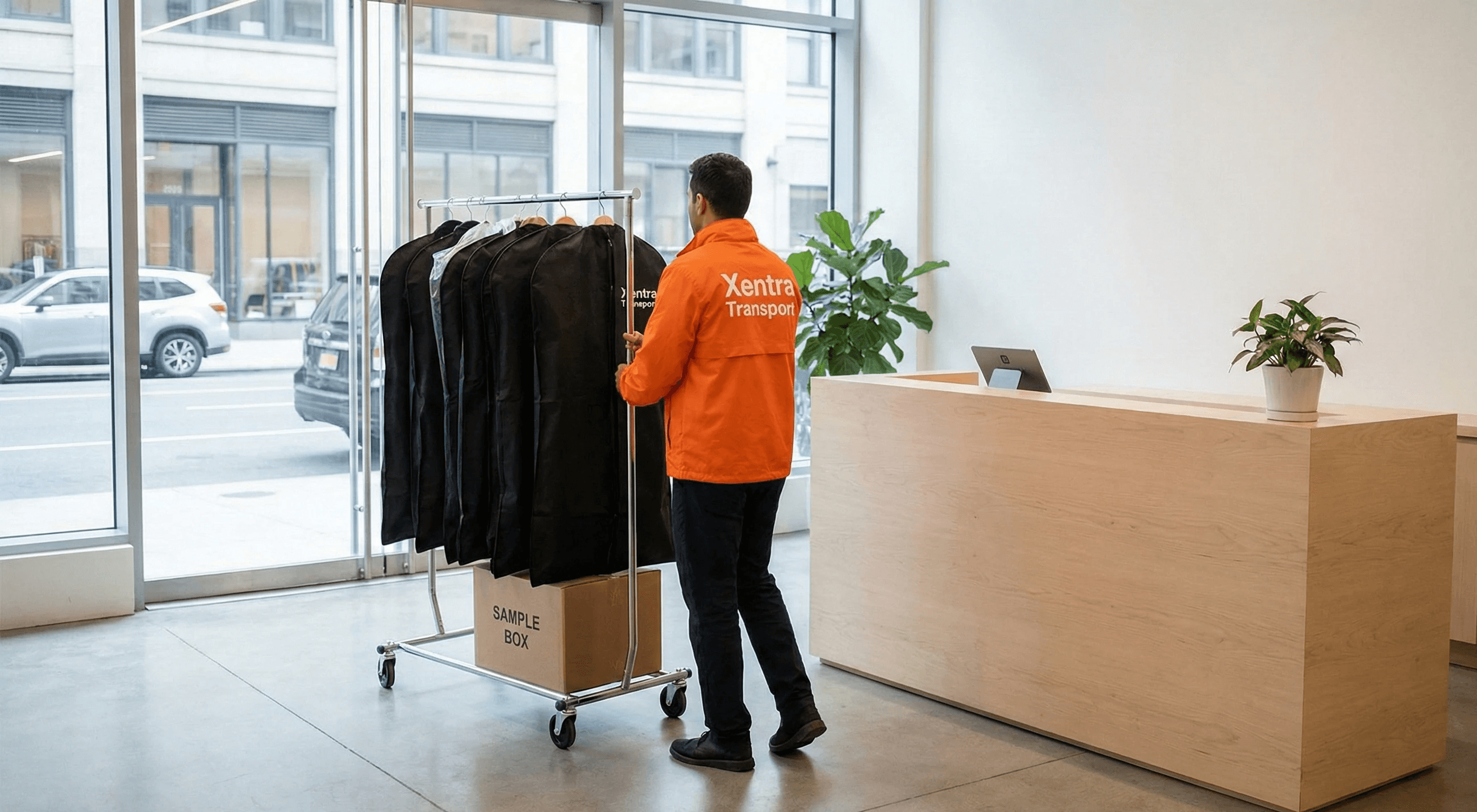
New York Fashion Week compresses months of movement into days. February and September turn every showroom, studio, and venue into a simultaneous load-in and load-out, with samples, look racks, steamers, backstage kits, and press materials all moving on the same congested blocks under fixed call times. A rack that arrives after the call time is a look that does not walk. Capacity on those dates is committed well in advance, and brands that book standing coverage rather than ad-hoc dispatch are the ones whose racks arrive before hair and makeup starts.
Market weeks and buying appointments generate a different pattern: full collections moving from showroom to buyer appointments and back, often several times a day, with sequencing that matters because the next appointment cannot start until the previous rack clears. This is dispatch-intensive, short-distance, high-frequency work — precisely the volume that multi-stop messenger routes are built for.
The corridors. Garment District showrooms to SoHo and Tribeca studios and PR offices; Midtown to the DUMBO, Williamsburg, and Bushwick photo-studio belt; Manhattan to Long Island City production and storage space; and the cross-Hudson run on the NY-to-NJ corridor to Secaucus and North Bergen warehousing, where a large share of the region's apparel inventory actually sits. E-commerce and wholesale fulfillment runs from those NJ warehouses back into city retail continuously — see our e-commerce and DTC practice.
The paper and print side of fashion moves too. Lookbooks, linesheets, press kits, seating charts, and event collateral run through our print and deliver service and our print shops, PR, and marketing agencies practice, usually against the same show calendar as the samples themselves. For a single small item on a tight clock inside the Manhattan core — a fitting sample, a swatch card, a signed contract — bike messenger service or on-demand messenger dispatch beats a van outright, and document delivery covers the contract side. Showroom and studio volume around Hudson Yards, Chelsea, and the West Village increasingly runs the same way.
Xentra Transport runs fashion sample delivery, rack transport, trim and production runs, lookbook and press distribution, and show and shoot logistics across NYC and the tri-state. Rail-equipped vehicles for hanging garments, two-person crews for full-collection moves, named-recipient handoffs, itemized manifests on both legs, and COIs issued at no charge. Call 877-709-2711 or set up standing coverage through an account before market week starts.
See Why They Choose Us
Showroom to Studio to Set — Same Day, On Hangers, Tracked
Book Sample Delivery
Meet Your Industry Needs Call Us


